

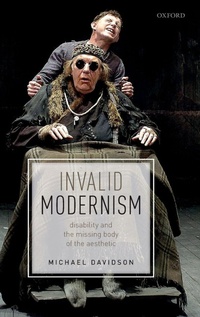
Invalid Modernism
Disability and the Missing Body of the Aesthetic
Published on 5. March 2019
Book
Hardback
222 pages
978-0-19-883281-2 (ISBN)
Description
Invalid Modernism contributes to an intersectional moment in disability studies by looking at modernist aesthetics through a 'defamiliar body'. It also offers an intersectional understanding of modernism by studying the representation of physical and cognitive difference during a period marked by progressive reforms in health, labor, and welfare. Readings of texts by Henry James, Samuel Beckett, Virginia Woolf, William Carlos Williams, James Joyce, Djuna Barnes, Oscar Wilde, F.T. Marinetti, Jean Toomer, an opera by Alexander Zemlinsky, and paintings and constructions by dadaists and surrealists are set against the historical developments in sexology, medical discourse, and the pseudo-sciences of eugenics and anthropometry.
Modernist works are well known for challenging formal features of narration and representation, but it is seldom observed that this challenge has often been enabled by figures of shell-shocked veterans, tubercular heroines, blind soothsayers, invalid aesthetes, and neurasthenic women. Such figures complicate an aesthetics of autonomy by which modernism is often understood. Since its evolution in the eighteenth century, aesthetics has been seen in terms of judgments based on detached appreciation. What begins as a highly privative, sensate response to an object or natural formation results in a disinterested judgment about the value of that response. By looking at modernist aesthetics through a disability optic, Invalid Modernism attempts to restore the missing body to aesthetics by disclosing a structure of feeling around dramatic changes in modernity. These changes are registered on and through the bodies and minds of figures considered in medical discourse of the period as 'invalid' citizens and subjects.
Modernist works are well known for challenging formal features of narration and representation, but it is seldom observed that this challenge has often been enabled by figures of shell-shocked veterans, tubercular heroines, blind soothsayers, invalid aesthetes, and neurasthenic women. Such figures complicate an aesthetics of autonomy by which modernism is often understood. Since its evolution in the eighteenth century, aesthetics has been seen in terms of judgments based on detached appreciation. What begins as a highly privative, sensate response to an object or natural formation results in a disinterested judgment about the value of that response. By looking at modernist aesthetics through a disability optic, Invalid Modernism attempts to restore the missing body to aesthetics by disclosing a structure of feeling around dramatic changes in modernity. These changes are registered on and through the bodies and minds of figures considered in medical discourse of the period as 'invalid' citizens and subjects.
More details
Language
English
Place of publication
Oxford
United Kingdom
Target group
Professional and scholarly
College/higher education
Illustrations
11 halftones
Dimensions
Height: 240 mm
Width: 161 mm
Thickness: 17 mm
Weight
502 gr
ISBN-13
978-0-19-883281-2 (9780198832812)
Copyright in bibliographic data and cover images is held by Nielsen Book Services Limited or by the publishers or by their respective licensors: all rights reserved.
Schweitzer Classification
Other editions
Additional editions
E-Book
02/2019
1st Edition
OUP eBook
€56.99
Available for download
E-Book
01/2019
1st Edition
OUP eBook
€56.99
Available for download
Person
Michael Davidson is Distinguished Professor Emeritus at the University of California, San Diego. He is the author of The San Francisco Renaissance: Poetics and Community at Mid-Century, Ghostlier Demarcations: Modern Poetry and the Material Word, Guys Like Us: Citing Masculinity in Cold War Poetics, and Outskirts of Form: Practicing Cultural Poetics. His work in disability studies can be seen in Concerto for the Left Hand: Disability and the Defamiliar Body published by the University of Michigan Press. He is the editor of The New Collected Poems of George Oppen. He is the author of six books of poetry, the most recent of which is Bleed Through: New and Selected Poems from Coffee House Press.
Content
Preface: Disorientations
Introduction: Disability, Modernism, and the Embodied Aesthetic
1: Invalid Modernism: A Diseased Aesthetic
2: 'The Rage of Caliban': The Mirror of Recognition
3: Exquisite Corporeality: Detachable Bodies of the Avant-Garde
4: 'Every Man His Speciality': Beckett and the Dialectics of Dependence
5: Pregnant Men: Biofuturity in Djuna Barnes and Virginia Woolf
6: Uncanny Encounters: Dramas of Contingency in Modernism
7: Missing Bodies: Disappearances in the Aesthetic
8: Cleavings: Critical Losses in the Politics of Deaf Gain
Introduction: Disability, Modernism, and the Embodied Aesthetic
1: Invalid Modernism: A Diseased Aesthetic
2: 'The Rage of Caliban': The Mirror of Recognition
3: Exquisite Corporeality: Detachable Bodies of the Avant-Garde
4: 'Every Man His Speciality': Beckett and the Dialectics of Dependence
5: Pregnant Men: Biofuturity in Djuna Barnes and Virginia Woolf
6: Uncanny Encounters: Dramas of Contingency in Modernism
7: Missing Bodies: Disappearances in the Aesthetic
8: Cleavings: Critical Losses in the Politics of Deaf Gain