

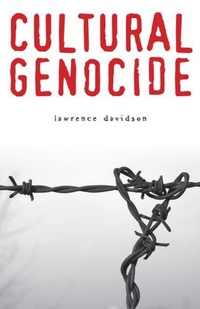
Cultural Genocide
Published on 8. March 2012
Book
Hardback
162 pages
978-0-8135-5243-9 (ISBN)
Description
Most scholars of genocide focus on mass murder. Lawrence Davidson, by contrast, explores the murder of culture. He suggests that when people have limited knowledge of the culture outside of their own group, they are unable to accurately assess the alleged threat of others around them. Throughout history, dominant populations have often dealt with these fears through mass murder. However, the shock of the Holocaust now deters today's great powers from the practice of physical genocide. Majority populations, cognizant of outside pressure and knowing that they should not resort to mass murder, have turned instead to cultural genocide as a "second best" politically determined substitute for physical genocide.
In Cultural Genocide, this theory is applied to events in four settings, two events that preceded the Holocaust and two events that followed it: the destruction of American Indians by uninformed settlers who viewed these natives as inferior and were more intent on removing them from the frontier than annihilating them; the attack on the culture of Eastern European Jews living within Russian-controlled areas before the Holocaust; the Israeli attack on Palestinian culture; and the absorption of Tibet by the People's Republic of China.
In conclusion, Davidson examines the mechanisms that may be used to combat today's cultural genocide as well as the contemporary social and political forces at work that must be overcome in the process.
In Cultural Genocide, this theory is applied to events in four settings, two events that preceded the Holocaust and two events that followed it: the destruction of American Indians by uninformed settlers who viewed these natives as inferior and were more intent on removing them from the frontier than annihilating them; the attack on the culture of Eastern European Jews living within Russian-controlled areas before the Holocaust; the Israeli attack on Palestinian culture; and the absorption of Tibet by the People's Republic of China.
In conclusion, Davidson examines the mechanisms that may be used to combat today's cultural genocide as well as the contemporary social and political forces at work that must be overcome in the process.
Reviews / Votes
"Davidson does not shy away from controversy as he seeks to challenge the thought collectives that justify everything from bulldozing villages and cultural sites to banning languages and religious practices. Recommended."(Choice) "Davidson provides us with a unique and creative way of looking at the phenomenon of collective violence and constructs a provocative, carefully argued, and at times unsettling, critique of the simplistic models." - Gary Fields (University of California, San Diego)
More details
Series
Language
English
Place of publication
New Brunswick NJ
United States
Target group
Professional and scholarly
Product notice
Cloth over boards
Dimensions
Height: 216 mm
Width: 140 mm
Thickness: 13 mm
Weight
330 gr
ISBN-13
978-0-8135-5243-9 (9780813552439)
Copyright in bibliographic data and cover images is held by Nielsen Book Services Limited or by the publishers or by their respective licensors: all rights reserved.
Schweitzer Classification
Other editions
Additional editions
Lawrence Davidson
Cultural Genocide
E-Book
03/2012
1st Edition
Rutgers University Press
€99.99
Available for download
Person
LAWRENCE DAVIDSON is a professor of history at West Chester University in Pennsylvania. He is the author of America's Palestine: Popular and Official Perceptions from Balfour to Israeli Statehood, Foreign Policy, Inc.: Privatizing America's National Interest and coauthor of A Concise History of the Middle East.
Content
1. Theoretical Foundations
2. Cultural Genocide and the American Indians
3. Russia and the Jews in the Nineteenth Century
4. Israel and Palestinian Cultural Genocide
5. The Chinese Assimilation of Tibet
6. Conclusion
Bibliography
Index
2. Cultural Genocide and the American Indians
3. Russia and the Jews in the Nineteenth Century
4. Israel and Palestinian Cultural Genocide
5. The Chinese Assimilation of Tibet
6. Conclusion
Bibliography
Index