

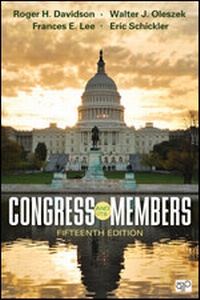
Congress and Its Members
15th Edition
Published on 27. October 2015
Book
Paperback/Softback
616 pages
978-1-4833-8888-5 (ISBN)
Description
"[Congress and Its Members] is the gold standard to which all Congress texts should aspire."
- Ross Baker, Rutgers, The State University of New Jersey
Congress and Its Members is the gold standard for courses on the U.S. Congress. It offers comprehensive coverage of the legislative branch and its process by looking at the tension between Congress as a lawmaking institution and as a collection of re-election-minded politicians. The Fifteenth Edition covers the 2014 midterm elections and includes discussions of the agenda of the new Congress, White House-Capitol Hill relations, party and committee leadership changes, judicial appointments, and partisan polarization. Offering a balance of great scholarship and currency, this best seller features lively case material along with relevant data, charts, exhibits, maps, and photos.
- Ross Baker, Rutgers, The State University of New Jersey
Congress and Its Members is the gold standard for courses on the U.S. Congress. It offers comprehensive coverage of the legislative branch and its process by looking at the tension between Congress as a lawmaking institution and as a collection of re-election-minded politicians. The Fifteenth Edition covers the 2014 midterm elections and includes discussions of the agenda of the new Congress, White House-Capitol Hill relations, party and committee leadership changes, judicial appointments, and partisan polarization. Offering a balance of great scholarship and currency, this best seller features lively case material along with relevant data, charts, exhibits, maps, and photos.
Reviews / Votes
"Congress and Its Members is very nearly perfect. I have found its structure to be enormously useful, and given how broad a goal it has, I think it works great. In particular, it is very well written and contains plenty of good examples that are essential to bringing such a peculiar institution as Congress to life. It is very clear the authors are experts on the topic, not just from an academic perspective but also from day-to-day real life experience." -- Elizabeth Palmer "I have used it throughout my teaching career because it is so complete and so easy for the students to understand....It is simply the best one can get." -- Kenneth Cosgrove "[Congress and Its Members] is the gold standard to which all Congress texts should aspire. It is comprehensive, well written, and well organized....The recent addition of Lee and Schickler as co-authors brings to the book freshness of perspective and good solid knowledge of the way Congress works." -- Ross BakerMore details
Edition
15th Revised edition
Language
English
Place of publication
Thousand Oaks
United States
Target group
College/higher education
Edition type
Revised edition
Dimensions
Height: 229 mm
Width: 152 mm
Weight
746 gr
ISBN-13
978-1-4833-8888-5 (9781483388885)
Copyright in bibliographic data and cover images is held by Nielsen Book Services Limited or by the publishers or by their respective licensors: all rights reserved.
Schweitzer Classification
Other editions
New editions
Roger H. Davidson | Walter J. Oleszek | Frances E. Lee
Congress and Its Members
Book
approx. 09/2017
16th Edition
CQ Press
€88.09
Not yet published
Previous edition
Roger H. Davidson | Walter J. Oleszek | Frances E. Lee
Congress and Its Members
Book
09/2013
14th Edition
CQ Press
€79.41
Article exhausted; check for reprint
Persons
Roger H. Davidson was professor emeritus of government and politics at the University
of Maryland and served as visiting professor of political science at the University of
California, Santa Barbara. He was a senior fellow of the National Academy of Public
Administration. During the 1970s, he served on the staffs of reform efforts in both the
House (Bolling-Martin Committee) and the Senate (Stevenson-Brock Committee).
For the 2001-2002 academic year, he served as the John Marshall chair in political
science at the University of Debrecen, Hungary. His books include Remaking
Congress: Change and Stability in the 1990s, co-edited with James A. Thurber (1995),
and Understanding the Presidency, 7th ed., co-edited with James P. Pfiffner (2013).
Davidson was co-editor with Donald C. Bacon and Morton Keller of The Encyclopedia
of the United States Congress (1995).
Walter J. Oleszek is a senior specialist in the legislative process at the Congressional
Research Service. He has served as either a full-time professional staff aide or consultant
to many major House and Senate congressional reorganization efforts beginning
with the passage of the Legislative Reorganization Act of 1970. In 1993, he served as
policy director of the Joint Committee on the Organization of Congress. A former
adjunct faculty member at American University, Oleszek is a frequent lecturer to various
academic, governmental, and business groups. He is the author or co-author of several
books, including Congressional Procedures and the Policy Process, 11th ed. (2020),
and Congress Under Fire: Reform Politics and the Republican Majority, with C. Lawrence
Evans (1997).
Frances E. Lee is professor of politics and public affairs in the School of Public and
International Affairs and the Department of Politics at Princeton University. She has
been a research fellow at the Brookings Institution and an APSA congressional fellow.
Most recently, she is co-author of The Limits of Party: Congress and Lawmaking in a
Polarized Era (2020). She is also the author of Insecure Majorities: Congress and the
Perpetual Campaign (2016) and Beyond Ideology: Politics, Principles, and Partisanship
in the U.S. Senate (2009) and co-author, with Bruce I. Oppenheimer, of Sizing Up
the Senate: The Unequal Consequences of Equal Representation (1999). Her articles have
appeared in the American Political Science Review, Journal of Politics, Legislative Studies
Quarterly, and American Journal of Political Science, among others.
Eric Schickler is Jeffrey & Ashley McDermott Professor of Political Science at the
University of California, Berkeley. He is the author of three books that have won the
Richard F. Fenno Jr. Prize for the best book on legislative politics: Disjointed Pluralism:
Institutional Innovation and the Development of the U.S. Congress (2001), Filibuster:
Obstruction and Lawmaking in the United States Senate (2006, with Gregory Wawro),
and Investigating the President: Congressional Checks on Presidential Power (2016, with
Douglas Kriner; also a winner of the Richard E. Neustadt Prize for the best book on
executive politics). His book Racial Realignment: The Transformation of American
Liberalism, 1932-1965 was the winner of the Woodrow Wilson Prize for the best book
on government, politics, or international affairs published in 2016, and is co-winner of
the J. David Greenstone Prize for the best book in history and politics from the previous
two calendar years. He is also the co-author of Partisan Hearts and Minds, which
was published in 2002.
of Maryland and served as visiting professor of political science at the University of
California, Santa Barbara. He was a senior fellow of the National Academy of Public
Administration. During the 1970s, he served on the staffs of reform efforts in both the
House (Bolling-Martin Committee) and the Senate (Stevenson-Brock Committee).
For the 2001-2002 academic year, he served as the John Marshall chair in political
science at the University of Debrecen, Hungary. His books include Remaking
Congress: Change and Stability in the 1990s, co-edited with James A. Thurber (1995),
and Understanding the Presidency, 7th ed., co-edited with James P. Pfiffner (2013).
Davidson was co-editor with Donald C. Bacon and Morton Keller of The Encyclopedia
of the United States Congress (1995).
Walter J. Oleszek is a senior specialist in the legislative process at the Congressional
Research Service. He has served as either a full-time professional staff aide or consultant
to many major House and Senate congressional reorganization efforts beginning
with the passage of the Legislative Reorganization Act of 1970. In 1993, he served as
policy director of the Joint Committee on the Organization of Congress. A former
adjunct faculty member at American University, Oleszek is a frequent lecturer to various
academic, governmental, and business groups. He is the author or co-author of several
books, including Congressional Procedures and the Policy Process, 11th ed. (2020),
and Congress Under Fire: Reform Politics and the Republican Majority, with C. Lawrence
Evans (1997).
Frances E. Lee is professor of politics and public affairs in the School of Public and
International Affairs and the Department of Politics at Princeton University. She has
been a research fellow at the Brookings Institution and an APSA congressional fellow.
Most recently, she is co-author of The Limits of Party: Congress and Lawmaking in a
Polarized Era (2020). She is also the author of Insecure Majorities: Congress and the
Perpetual Campaign (2016) and Beyond Ideology: Politics, Principles, and Partisanship
in the U.S. Senate (2009) and co-author, with Bruce I. Oppenheimer, of Sizing Up
the Senate: The Unequal Consequences of Equal Representation (1999). Her articles have
appeared in the American Political Science Review, Journal of Politics, Legislative Studies
Quarterly, and American Journal of Political Science, among others.
Eric Schickler is Jeffrey & Ashley McDermott Professor of Political Science at the
University of California, Berkeley. He is the author of three books that have won the
Richard F. Fenno Jr. Prize for the best book on legislative politics: Disjointed Pluralism:
Institutional Innovation and the Development of the U.S. Congress (2001), Filibuster:
Obstruction and Lawmaking in the United States Senate (2006, with Gregory Wawro),
and Investigating the President: Congressional Checks on Presidential Power (2016, with
Douglas Kriner; also a winner of the Richard E. Neustadt Prize for the best book on
executive politics). His book Racial Realignment: The Transformation of American
Liberalism, 1932-1965 was the winner of the Woodrow Wilson Prize for the best book
on government, politics, or international affairs published in 2016, and is co-winner of
the J. David Greenstone Prize for the best book in history and politics from the previous
two calendar years. He is also the co-author of Partisan Hearts and Minds, which
was published in 2002.
Content
Part I: In Search of the Two Congresses
Chapter 1: The Two Congresses
The Dual Nature of Congress
The Two Congresses in Comparative Context
Divergent Views of Congress
Chapter 2: Evolution of the Modern Congress
Antecedents of Congress
Congress in the Constitution
Institutional Evolution
Evolution of the Legislator's Job
Conclusion
Part II: A Congress of Ambassadors
Chapter 3: Going for It: Recruitment and Candidacy
Formal Rules of the Game
Districting in the House
Becoming a Candidate
Nominating Politics
Conclusion
Chapter 4: Making It: The Electoral Game
Campaign Strategies
Campaign Resources
Campaign Techniques
The Parallel Campaigns
Who Votes?
How Voters Decide
Election Outcomes
Conclusion
Chapter 5: Being There: Hill Styles and Home Styles
Hill Styles
Looking Homeward
Office of the Member Inc.
Members and the Media
Conclusion
Part III: A Deliberative Assembly of One Nation
Chapter 6: Leaders and Parties in Congress
The Speaker of the House
Leaders of the Senate
Selection of Leaders
Leadership Activities
Party Caucuses, Committees, and Informal Groups
Party Continuity and Change
Conclusion
Chapter 7: Committees: Workshops of Congress
The Purposes of Committees
Evolution of the Committee System
Types of Committees
The Assignment Process
Committee Leadership
Policy Making in Committee
Committee Staff
Committee Reform and Change
Conclusion
Chapter 8: Congressional Rules and Procedures
Introduction of Bills
Referral of Bills
Scheduling in the House
House Floor Procedures
Scheduling in the Senate
Senate Floor Procedures
Resolving House-Senate Differences
Conclusion
Chapter 9: Decision Making in Congress
The Power to Choose
Types of Decisions
Determinants of Voting
Legislative Bargaining
Conclusion
Part IV: Policy Making and Change in the Two Congresses
Chapter 10: Congress and the President
The President as Legislator
The Veto Power
Sources of Legislative-Executive Cooperation
Sources of Legislative-Executive Conflict
The Balance of Power
Conclusion
Chapter 11: Congress and the Bureaucracy
Congress Organizes the Executive Branch
Congressional Control of the Bureaucracy
Conclusion
Chapter 12: Congress and the Courts
The Federal Courts
The Court as Referee and Umpire
Advice and Consent for Judicial Nominees
Conclusion
Chapter 13: Congress and Organized Interests
American Pluralism
Pressure Group Methods
Groups and the Electoral Connection
Groups, Lobbying, and Legislative Politics
Regulation of Lobbying
Conclusion
Chapter 14: Congress, Budgets, and Domestic Policy Making
Stages of Policy Making
Types of Domestic Policies
Characteristics of Congressional Policy Making
Congressional Budgeting
The 1974 Budget Act
Conclusion
Chapter 15: Congress and National Security Policies
Constitutional Powers
Who Speaks for Congress?
Types of Foreign and National Security Policies
Structural Policies
Strategic Policies
Crisis Policies: The War Powers
Conclusion
Part V: Conclusion
Chapter 16: The Two Congresses and the American People
Congress-as-Politicians
Congress-as-Institution
Twenty-First-Century Challenges
Chapter 1: The Two Congresses
The Dual Nature of Congress
The Two Congresses in Comparative Context
Divergent Views of Congress
Chapter 2: Evolution of the Modern Congress
Antecedents of Congress
Congress in the Constitution
Institutional Evolution
Evolution of the Legislator's Job
Conclusion
Part II: A Congress of Ambassadors
Chapter 3: Going for It: Recruitment and Candidacy
Formal Rules of the Game
Districting in the House
Becoming a Candidate
Nominating Politics
Conclusion
Chapter 4: Making It: The Electoral Game
Campaign Strategies
Campaign Resources
Campaign Techniques
The Parallel Campaigns
Who Votes?
How Voters Decide
Election Outcomes
Conclusion
Chapter 5: Being There: Hill Styles and Home Styles
Hill Styles
Looking Homeward
Office of the Member Inc.
Members and the Media
Conclusion
Part III: A Deliberative Assembly of One Nation
Chapter 6: Leaders and Parties in Congress
The Speaker of the House
Leaders of the Senate
Selection of Leaders
Leadership Activities
Party Caucuses, Committees, and Informal Groups
Party Continuity and Change
Conclusion
Chapter 7: Committees: Workshops of Congress
The Purposes of Committees
Evolution of the Committee System
Types of Committees
The Assignment Process
Committee Leadership
Policy Making in Committee
Committee Staff
Committee Reform and Change
Conclusion
Chapter 8: Congressional Rules and Procedures
Introduction of Bills
Referral of Bills
Scheduling in the House
House Floor Procedures
Scheduling in the Senate
Senate Floor Procedures
Resolving House-Senate Differences
Conclusion
Chapter 9: Decision Making in Congress
The Power to Choose
Types of Decisions
Determinants of Voting
Legislative Bargaining
Conclusion
Part IV: Policy Making and Change in the Two Congresses
Chapter 10: Congress and the President
The President as Legislator
The Veto Power
Sources of Legislative-Executive Cooperation
Sources of Legislative-Executive Conflict
The Balance of Power
Conclusion
Chapter 11: Congress and the Bureaucracy
Congress Organizes the Executive Branch
Congressional Control of the Bureaucracy
Conclusion
Chapter 12: Congress and the Courts
The Federal Courts
The Court as Referee and Umpire
Advice and Consent for Judicial Nominees
Conclusion
Chapter 13: Congress and Organized Interests
American Pluralism
Pressure Group Methods
Groups and the Electoral Connection
Groups, Lobbying, and Legislative Politics
Regulation of Lobbying
Conclusion
Chapter 14: Congress, Budgets, and Domestic Policy Making
Stages of Policy Making
Types of Domestic Policies
Characteristics of Congressional Policy Making
Congressional Budgeting
The 1974 Budget Act
Conclusion
Chapter 15: Congress and National Security Policies
Constitutional Powers
Who Speaks for Congress?
Types of Foreign and National Security Policies
Structural Policies
Strategic Policies
Crisis Policies: The War Powers
Conclusion
Part V: Conclusion
Chapter 16: The Two Congresses and the American People
Congress-as-Politicians
Congress-as-Institution
Twenty-First-Century Challenges