

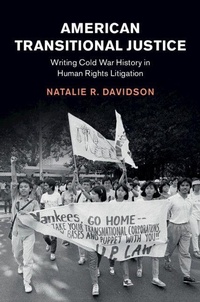
American Transitional Justice
Writing Cold War History in Human Rights Litigation
Published on 2. July 2020
Book
Hardback
220 pages
978-1-108-47770-3 (ISBN)
Description
Natalie Davidson offers an alternative account of Alien Tort Statute litigation by revisiting the field's two seminal cases, Filartiga (filed 1979) and Marcos (filed 1986), lawsuits ostensibly concerned with torture in Paraguay and the Philippines, respectively. Combining legal analysis, archival research and ethnographic methods, this book reveals how these cases operated as transitional justice mechanisms, performing the transition of the United States and its allies out of the Cold War order. It shows that US courts produced a whitewashed history of US involvement in repression in the Western bloc, while in Paraguay and the Philippines the distance from US courts allowed for a more critical narration of the lawsuits and their underlying violence as symptomatic of structural injustice. By exposing the political meanings of these legal landmarks for three societies, Davidson sheds light on the blend of hegemonic and emancipatory implications of international human rights litigation in US courts.
Reviews / Votes
'In this excellent and timely book, Davidson pushes the study of transitional justice away from its familiar focus on criminal proceedings and truth commissions towards a richer reckoning with the full range of legal mechanisms through which a politics of emancipation can be pursued. No less distinctively and originally, Davidson brings into sharp relief how legal actors pursuing rather local goals can nevertheless powerfully advance the larger interests of justice.' Lawrence Douglas, Amherst College, Massachusetts 'Davidson's extensive on-the-ground research sheds new light on the achievements, limitations and perverse ways in which human rights litigation in the U.S. plays out. She brings a critical perspective that is nuanced and sophisticated, drawing from current work in human rights, anthropology, discourse studies as well as law.' Naomi Roht-Arriaza, University of California, Hastings Law 'To what extent has America been held accountable for its conduct abroad during the Cold War? Read this book for an insightful interdisciplinary inquiry into the pursuit of justice through human rights litigation.' Ruti Teitel, Ernst C. Stiefel Professor of Comparative Law, New York Law SchoolMore details
Series
Language
English
Place of publication
Cambridge
United Kingdom
Target group
Professional and scholarly
Product notice
sewn/stitched
Cloth over boards
Illustrations
Worked examples or Exercises
Dimensions
Height: 229 mm
Width: 152 mm
Thickness: 14 mm
Weight
463 gr
ISBN-13
978-1-108-47770-3 (9781108477703)
Copyright in bibliographic data and cover images is held by Nielsen Book Services Limited or by the publishers or by their respective licensors: all rights reserved.
Schweitzer Classification
Other editions
Additional editions
Natalie R. Davidson
American Transitional Justice
Writing Cold War History in Human Rights Litigation
Book
11/2022
Cambridge University Press
€32.00
Shipment within 15-20 days
Natalie R. Davidson
American Transitional Justice
Writing Cold War History in Human Rights Litigation
E-Book
07/2020
Cambridge University Press
€73.99
Available for download
Natalie R. Davidson
American Transitional Justice
Writing Cold War History in Human Rights Litigation
E-Book
06/2020
Cambridge University Press
€23.49
Available for download
Person
Natalie Davidson is a Lecturer in the Faculty of Law at Tel-Aviv University. She has published about Alien Tort Statute litigation, feminist interventions in international law, the prohibition of torture, and interdisciplinary methodology.
Content
1. Introduction. Revisiting the Gilded Age of transnational human rights litigation in US courts; 2. Alien tort statute litigation in legal practice and the legal imagination; 3. 'Foreign torture, American justice': Filartiga in the United States; 4. Filartiga in Paraguay; 5. Narrating the Marcos regime in US courts; 6. The Marcos case and transitional justice in the Philippines; 7. Conclusion.