

Democratic Education as Inclusion
Published on 22. August 2023
Book
Paperback/Softback
154 pages
978-1-7936-5238-6 (ISBN)
Description
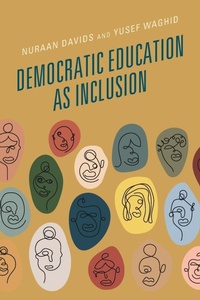
Political and social expectations are often stymied and distorted by individual and communal identities-creating vastly incongruent and unrelated lived experiences, often within the same context. Democratic Education as Inclusion explores how the existence and enactments of diversity continue to present ubiquitous epicenters of misreading, misrecognition, and missed opportunities for peaceful co-existence-whether in established, or nascent democracies. Nuraan Davids and Yusef Waghid study how the public sphere has never held the same meaning to all individuals or groups. As such, there are deep implications for differentiated experiences of citizenship, between those who are included in the center of the sphere, and those who are excluded on the margins. This book explains the dyadic relationship between inclusion and exclusion and how it is not limited to the public sphere, or to broader conceptions of democratic citizenship. It is as apparent in educational settings, presenting under-explored complexities not only for teaching and learning, but for the life experiences of participants in teaching-learning. Often the foundational norms put into place during educational initiations become the primary determinants of how young people conceive of themselves as citizens, and how they conceive of themselves in relation to others.
Reviews / Votes
While democracy is idealised around the world, equal access to the rights and sense of belonging associated with democratic citizenship remains out of reach for many people living in democratic societies today. In Democratic Education as Inclusion, Davids and Waghid consider who is included and excluded and how in democratic spaces. Drawing on a wide range of thinkers, they create a richly layered account of how identity, belonging, inclusion, and exclusion are interwoven in public spaces. In so doing, they elucidate the critical need to rethink cherished concepts like democracy and equality and troublesome ideas about race, ethnicity, and gender, reaffirming the vital task of examining education as a site for greater social justice. -- Liz Jackson, Education University of Hong Kong Davids and Waghid have written a nuanced analysis of why we should eshew a politics of individualism in favour of a philosophy that puts community at the heart of citizenship education. They demonstrate how the concept of Ubuntu encompasses human dignity and respect and offers a foundation of solidarity to enable consensual modes of engagement which are foundational to democratic citizenship. Their grounding in the South African context has much to teach us internationally and is highly pertinent to the UK context. -- Ruth Heilbronn, UCL Institute of Education This wonderful volume carefully weaves together different threads around race and ethnicity, gender, intersectionality, inclusion and equality to craft a persuasive and original philosophical contribution to the field. The resulting beauty of its tapestry shows how democratic citizenship education and cosmopolitan education are not mutually exclusive, but offer an original provocation for how we might inhabit the world. Its rich and timely scholarship has profound implications not only for our schools, universities, and for the field of philosophy of education, but also for how we express our own identity, and for how we give attentiveness to the other in all its otherness. -- Amanda Fulford, Edge Hill UniversityMore details
Language
English
Place of publication
United States
Publishing group
Bloomsbury Publishing Plc
Target group
Professional and scholarly
Dimensions
Height: 229 mm
Width: 152 mm
Thickness: 9 mm
Weight
237 gr
ISBN-13
978-1-7936-5238-6 (9781793652386)
Copyright in bibliographic data and cover images is held by Nielsen Book Services Limited or by the publishers or by their respective licensors: all rights reserved.
Schweitzer Classification
Other editions
Additional editions
Nuraan Davids | Yusef Waghid
Democratic Education as Inclusion
E-Book
02/2022
1st Edition
Bloomsbury eBooks US
€33.99
Available for download
Persons
Nuraan Davids is associate professor of philosophy of education, and the chairperson of the Department of Education Policy Studies in the faculty of education at Stellenbosch University.
Yusef Waghid is distinguished professor of philosophy of education in the Department of Education Policy Studies at Stellenbosch University.
Yusef Waghid is distinguished professor of philosophy of education in the Department of Education Policy Studies at Stellenbosch University.
Content
Foreword: The Just Demands of Democratic Inclusion: Ubuntu Communities and Democratic Education, by Ronald David Glass
Preface
Chapter 1: Democratic inclusion/exclusion: On an imagined commensurability
Chapter 2: Democratic citizenship education and dissensus as inclusion
Chapter 3: Race as a social (re)construction of exclusion
Chapter 4: Intersectionality, race and ethnicity
Chapter 5: Gender and citizenship: conceptions and contestations
Chapter 6: Equality as an imperative for democratic citizenship education
Chapter 7: Under-representation as a pervasive impediment to democratic education
Chapter 8: Why representation matters in teaching and learning
Chapter 9: Democratic citizenship education revisited: Re-opening debate about engagement and belonging
Chapter 10: Democratic citizenship education versus cosmopolitan education: an unwelcome contestation or not?
Bibliography
About the authors
Preface
Chapter 1: Democratic inclusion/exclusion: On an imagined commensurability
Chapter 2: Democratic citizenship education and dissensus as inclusion
Chapter 3: Race as a social (re)construction of exclusion
Chapter 4: Intersectionality, race and ethnicity
Chapter 5: Gender and citizenship: conceptions and contestations
Chapter 6: Equality as an imperative for democratic citizenship education
Chapter 7: Under-representation as a pervasive impediment to democratic education
Chapter 8: Why representation matters in teaching and learning
Chapter 9: Democratic citizenship education revisited: Re-opening debate about engagement and belonging
Chapter 10: Democratic citizenship education versus cosmopolitan education: an unwelcome contestation or not?
Bibliography
About the authors