

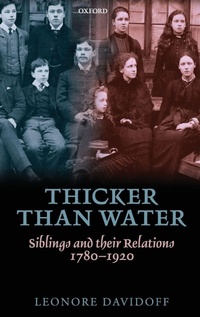
Thicker Than Water
Siblings and Their Relations, 1780-1920
Published on 24. November 2011
Book
Hardback
464 pages
978-0-19-954648-0 (ISBN)
Description
Brothers and sisters remain, for those that have them, an inextricable part of existence. In adult life they may never be in contact but they cannot be formally divorced. Brothers and sisters are frequently life's longest relationship. Yet until recently, historians have scarcely noticed. Thicker than Water is a pioneering history of sibling relationships in the long nineteenth century, from the last decades of the eighteenth to the first decades of the twentieth. The principal focus is on Britain, the first major capitalist society, and its middle classes, who were at the core of the nascent new order. It was their extensive family networks that provided the capital, personnel, skills, and contacts crucial to the rapidly expanding commercial and professional enterprises of the Victorian era. Davidoff examines what we know about sibling relationships at this time, before delving deeper, looking at their uses and meaning for British middle class families, how they operated within the economic, social, cultural, and religious constraints of their place and time, and how they changed as families became smaller from the end of the nineteenth century onwards.
The issues raised throughout the book are grounded in an exploration of some specific themes, sibling intimacy and incest, sibling death, as well as in case studies of famous sibling relationships, such as that between William Gladstone and his sisters, and a revealing account of the household relations of perhaps the most influential interpreter of personal and familial life in modern society, Sigmund Freud.
The issues raised throughout the book are grounded in an exploration of some specific themes, sibling intimacy and incest, sibling death, as well as in case studies of famous sibling relationships, such as that between William Gladstone and his sisters, and a revealing account of the household relations of perhaps the most influential interpreter of personal and familial life in modern society, Sigmund Freud.
Reviews / Votes
The ideas of sisterhoods and brotherhoods are not new; however, these have seldom involved actual sibling relationships. In this fascinating volume about family relationships in Britain and Europe during a 140-year time span, Davidoff (sociology, Univ. of Essex, UK) examines those consanguineal relations so often passed over by historians. S. J. Zuber-Chall, CHOICE A fascinating study of the networks that large, middle-class, professional families established in the long 19th century. Auriol Stevens, Times Higher Education Supplement Historians and general readers alike will relish this book. Jane Hamlett, History Today An intriguing read. Who Do You Think You Are? Davidoff succeeds in demonstrating both the strangeness of the past and its relevance to the contemporary world where in the absence of a range of siblings young people begin to think of their friends as part of their family. Hugh Cunningham, Journal of Social HistoryMore details
Language
English
Place of publication
Oxford
United Kingdom
Target group
College/higher education
Professional and scholarly
Product notice
sewn/stitched
Cloth over boards
Illustrations
19 black and white halftones
Dimensions
Height: 240 mm
Width: 166 mm
Thickness: 28 mm
Weight
925 gr
ISBN-13
978-0-19-954648-0 (9780199546480)
Copyright in bibliographic data and cover images is held by Nielsen Book Services Limited or by the publishers or by their respective licensors: all rights reserved.
Schweitzer Classification
Other editions
Additional editions
Book
08/2013
Oxford University Press
€56.80
Shipment within 15-20 days
Person
Leonore Davidoff is a Research Professor in the Department of Sociology at the University of Essex. She has held visiting professorships and fellowships in the US, Australia, Sweden, and several other European countries. Her main area of research is the relationship between the family and economic organization in the period of nascent capitalist development from around 1780 to 1920. She has also pioneered the history of gender relations and in 1987 she became Founding Editor of Gender and History.
Content
Introduction ; PART I: EXPLORING KIN AND THEIR KIND ; 1. Kin and Family: Academic Disciplines and Expert Opinions ; 2. Finding Siblings ; PART II: THE LATTICE OF KINSHIP: A HISTORICAL CASE STUDY ; 3. The People and the Setting ; 4. The 'Long' Family and Its Decline ; 5. A Like, Unlike: Siblings in Childhood and Youth ; 6. A Dance of Intimacy and Separation: Siblings in Adulthood ; 7. Forgotten Figures: Aunts, Uncles, Nephews, Nieces and Cousins ; PART III: LIFE'S LONGEST RELATIONSHIP: ESSAYS ON SIBLING THEMES ; 8. Sibling Intimacy and the Question of Incest ; 9. The Rise and Fall of Close Marriage ; 10. Gender, Age and Authority: Anne, William Ewart and Helen Gladstone ; 11. Sibling Silences: The Freud Family ; 12. Sibling Loss ; Conclusion ; Bibliography ; Index