

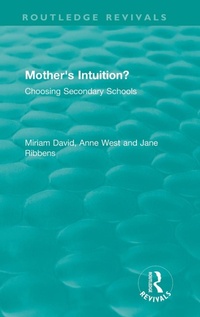
Mother's Intuition? (1994)
Choosing Secondary Schools
1st Edition
Published on 20. November 2017
Book
Hardback
172 pages
978-1-138-57795-4 (ISBN)
Description
Published in 1994, Mother's Intuition? examines the process of choosing secondary schools in two inner London boroughs. The research is based upon detailed interviews with parents as well as questionnaires filled in by pupils themselves. The authors address several important dimensions in the choosing process which had not been investigated by previous research. The book particularly focusses on the main question arising from the interviews; who does the choosing - mother, father or the child? Other areas discussed are the changing nature of families and the role different members in lone parent families play, as well as the different decisions made between families with girls and boys, and those from different racial and ethnic groups.
More details
Series
Language
English
Place of publication
London
United Kingdom
Publishing group
Taylor & Francis Ltd
Target group
College/higher education
Dimensions
Height: 240 mm
Width: 161 mm
Thickness: 14 mm
Weight
432 gr
ISBN-13
978-1-138-57795-4 (9781138577954)
Copyright in bibliographic data and cover images is held by Nielsen Book Services Limited or by the publishers or by their respective licensors: all rights reserved.
Schweitzer Classification
Other editions
Additional editions
Book
07/2019
1st Edition
Routledge
€39.80
Shipment within 10-20 days
E-Book
02/2018
Routledge
€22.49
Available for download
E-Book
02/2018
Routledge
€22.49
Available for download
Persons
Content
Introduction. Contexts and Concepts: Parental Choice or Chosen Parents? 1. Choice of Research Design. 2. Characteristics of the Children and their Families. 3. Who makes the Choice - Mothers, Fathers, Children or Altogether? 4. Parents' Appreciation of Procedures about School Transfer. 5. Parents' Reasons for Choice of Preferred Secondary School. 6. 'Discipline' and Parents' rejection of Certain Schools. 7. Choice in Broader Context of Family Life: Memories, Attitudes, Hope and Expectations. 8. The Pupils' Stories of Choice. 9. Conclusions: Choice, Control and Compromise?