

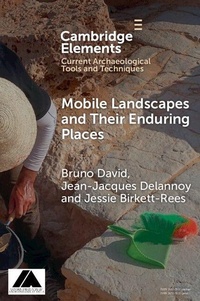
Mobile Landscapes and Their Enduring Places
Published on 4. April 2024
Book
Paperback/Softback
110 pages
978-1-009-18158-7 (ISBN)
Description
This Element presents emerging concepts and analytical tools in landscape archaeology. In three major sections bookended by an Introduction and Conclusion, the Element discusses current and emerging ideas and methods by which to explore how people in the past engaged with each other and their physical settings across the landscape, creating their lived environments in the process. The Element reviews the scales and temporalities that inform the study of human movements in and between places. Learning about how people engaged with each other at individual sites and across the landscape deep in the past is best achieved through transdisciplinary approaches, in which archaeologists integrate their methods with those of other specialists. The Element introduces these ideas through new research and multiple case studies from around the world, culminating in how to 'archaeomorphologically' map anthropic constructions in caves and their contemporary environments.
More details
Series
Language
English
Place of publication
Cambridge
United Kingdom
Edition type
New edition
Product notice
Paperback (trade)
Illustrations
Worked examples or Exercises
Dimensions
Height: 229 mm
Width: 152 mm
Thickness: 6 mm
Weight
159 gr
ISBN-13
978-1-009-18158-7 (9781009181587)
Copyright in bibliographic data and cover images is held by Nielsen Book Services Limited or by the publishers or by their respective licensors: all rights reserved.
Schweitzer Classification
Other editions
Additional editions
Bruno David | Jean-Jacques Delannoy | Jessie Birkett-Rees
Mobile Landscapes and Their Enduring Places
Book
04/2024
Cambridge University Press
€78.00
Shipment within 15-20 days
Persons
Content
1. Introduction; 2. Moving across the landscape: the temporality of place; 3. The physical landscapes of past societies; 4. Mappings: archaeomorphology and the created environment; 5. Conclusion; References.