

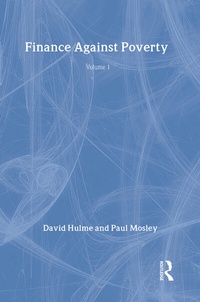
Finance Against Poverty: Volume 1
1st Edition
Will be published approx. on 12. September 1996
Book
Hardback
240 pages
978-0-415-09544-0 (ISBN)
Description
In two volumes these books review and expand the theory that poverty in the world's poorest regions could be alleviated by providing small loans to micro-entrepreneurs. Volume 1 provides detailed analysis of this theory and offers policy recommendations for practitioners in this field. Volume 2 presents empirical evidence drawn from comparative experiences in seven developing countries. The work assesses the success of this policy and provides some startling conclusions. This is essential reading for all those interested in development, poverty-reduction, social welfare and finance.
More details
Language
English
Place of publication
London
United Kingdom
Publishing group
Taylor & Francis Ltd
Target group
College/higher education
Professional and scholarly
Dimensions
Height: 234 mm
Width: 156 mm
Weight
453 gr
ISBN-13
978-0-415-09544-0 (9780415095440)
Copyright in bibliographic data and cover images is held by Nielsen Book Services Limited or by the publishers or by their respective licensors: all rights reserved.
Schweitzer Classification
Other editions
Additional editions
Hulme David | Paul Mosley
Finance Against Poverty: Volume 1
E-Book
08/2005
Routledge
€89.99
Available for download
Hulme David | Paul Mosley
Finance Against Poverty: Volume 1
E-Book
08/2005
Routledge
€89.99
Available for download
Book
09/1996
1st Edition
Routledge
€95.70
Shipment within 15-20 days
Persons
David Hulme is Professor of Development Studies and Director of the Institute for Development Policy and Management at the University of Manchester. Paul Mosley is Professor of Economics and Director of the International Development Centre at Reading University.
Content
Preface 1 WHY DEVELOPMENT FINANCE INSTITUTIONS EXIST Market failure versus government failure 2 WHY CREDIT MARKETS FAIL THE POOR 3 FINANCIAL PERFORMANCE AND SUSTAINABILITY The role of 'innovative credit institutions' in the capital market 4 THE IMPACT ON PRODUCTION AND TECHNOLOGY 5 FINANCE FOR THE POOR Impacts on poverty, vulnerability and deprivation 6 THE POLITICS OF FINANCIAL INTERMEDIATION FOR THE POOR 7 THE MANAGEMENT OF FINANCIAL INSTITUTIONS FOR THE POOR 8 GROWTH VERSUS EQUITY? 9 CONCLUSIONS