

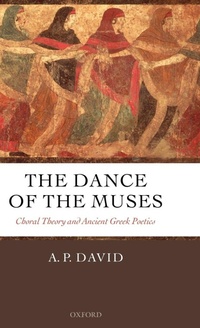
The Dance of the Muses
Choral Theory and Ancient Greek Poetics
Published on 28. September 2006
Book
Hardback
304 pages
978-0-19-929240-0 (ISBN)
Description
This book develops an authentic and at the same time revolutionary musical analysis of ancient Greek poetry. It departs from the abstract metrical analyses of the past in that it conceives the rhythmic and harmonic elements of poetry as integral to the whole expression, and decisive in the interpretation of its meaning. David offers a thoroughgoing treatment of Homeric poetics: here some remarkable discoveries in the harmonic movement of epic verse, when combined with some neglected facts about the origin of the hexameter in a 'dance of the Muses', lead to essential new thinking about the genesis and the form of Homeric poetry. He also gives a foretaste of the fruits to be harvested in lyric by a musical analysis, which applies a new theory of the Greek tonic accent and considers concretely the role of dance in performance.
Reviews / Votes
...David often asks important questions that the scholarly discourse tends to avoid, and soemtimes proposes fascinating answers... * Stefan Hagel, GNOMON * develops a new approach to the interpretation of ancient Greek poetry * Massimo Giuseppetti, The Classical Review *More details
Language
English
Place of publication
Oxford
United Kingdom
Target group
Professional and scholarly
Dimensions
Height: 222 mm
Width: 145 mm
Thickness: 21 mm
Weight
557 gr
ISBN-13
978-0-19-929240-0 (9780199292400)
Copyright in bibliographic data and cover images is held by Nielsen Book Services Limited or by the publishers or by their respective licensors: all rights reserved.
Schweitzer Classification
Person
A. P. David completed his Ph.D. at the University of Chicago.
Content
1. Introduction: the right comparison ; 2. Choreia and the musical text ; 3. The voice of the dancer: a new theory of the Greek accent ; 4. The form of the hexameter: the origins of caesura and diaeresis ; 5. The 'choral signifier': the shaping of Homeric speech ; 6. Retrogression, episode, and anagogy: the round dance and narrative form ; 7. The genesis of Homeric poetry (a brief synthesis): the 'intemporizing' cataloguer ; 8. The lyric orchestra