

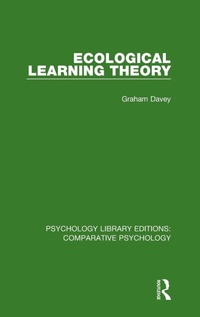
Ecological Learning Theory
1st Edition
Published on 22. February 2018
Book
Hardback
410 pages
978-1-138-55486-3 (ISBN)
Description
Originally published in 1989, this title presents a view of adaptive behaviour which integrates both evolutionary and psychological perspectives on learning. The study of learning, and in particular conditioning, had evolved in isolation from the rest of the biological sciences, and until the late 1980s had largely ignored the fact that learning processes are adaptive functions subject to the pressures of evolutionary selection. This text is designed to give a thorough insight into contemporary views of learning mechanisms, at the same time incorporating an evolutionary perspective on the function and performance of learning.
Graham Davey gives a detailed introduction to evolutionary approaches to behaviour and basic learning phenomena such as Pavlovian and instrumental conditioning. He also provides a comparative introduction to both learning and performance aspects of conditioning. He covers ecological approaches to adaptive behaviour (e.g. foraging theory), specialized learning processes such as concept formation, spatial learning, and language learning.
Innovative in its integration of ecological and evolutionary approaches with more traditional associative views of learning, the book introduces the reader to learning in a very wide variety of species other than the traditional laboratory rat and pigeon. It will be valuable to anyone with a general interest in animal behaviour, and also to those with a specific interest in learning, adaptive behaviour, and evolutionary approaches to behaviour.
Graham Davey gives a detailed introduction to evolutionary approaches to behaviour and basic learning phenomena such as Pavlovian and instrumental conditioning. He also provides a comparative introduction to both learning and performance aspects of conditioning. He covers ecological approaches to adaptive behaviour (e.g. foraging theory), specialized learning processes such as concept formation, spatial learning, and language learning.
Innovative in its integration of ecological and evolutionary approaches with more traditional associative views of learning, the book introduces the reader to learning in a very wide variety of species other than the traditional laboratory rat and pigeon. It will be valuable to anyone with a general interest in animal behaviour, and also to those with a specific interest in learning, adaptive behaviour, and evolutionary approaches to behaviour.
More details
Series
Language
English
Place of publication
London
United Kingdom
Publishing group
Taylor & Francis Ltd
Target group
College/higher education
Professional and scholarly
Product notice
sewn/stitched
Cloth over boards
Dimensions
Height: 234 mm
Width: 156 mm
Thickness: 24 mm
Weight
753 gr
ISBN-13
978-1-138-55486-3 (9781138554863)
Copyright in bibliographic data and cover images is held by Nielsen Book Services Limited or by the publishers or by their respective licensors: all rights reserved.
Schweitzer Classification
Other editions
Additional editions
Graham Davey
Ecological Learning Theory
Book
03/2020
1st Edition
Routledge
€55.30
Shipment within 10-20 days
Graham Davey
Ecological Learning Theory
E-Book
02/2018
1st Edition
Routledge
€47.49
Available for download
Person
Graham Davey
Content
List of Illustrations. Preface. 1. Ecology. Evolution, and Learning 2. Comparative Aspects of Conditioning: Pavlovian Learning 3. Comparative Aspects of Conditioning: Instrumental Learning 4. Cognitive Aspects of Conditioning: Associations, Representations, and Memories 5. Performance Models of Pavlovian Conditioning 6. The Biological Function of Pavlovian Conditioning 7. Instrumental Conditioning: Learning Mechanisms, Performance, and Function 8. Behavioural Ecology 9. Phase-Specific Learning: Imprinting and Avian Song Learning 10. Learning and Intelligence. Journal and Periodical Abbreviations. Bibliography. Name Index. Species Index. Subject Index.