

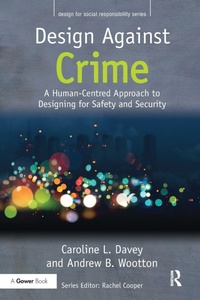
Design Against Crime
A Human-Centred Approach to Designing for Safety and Security
1st Edition
Published on 30. September 2020
Book
Paperback/Softback
154 pages
978-0-367-66990-4 (ISBN)
Description
Design Against Crime will aid the design profession to meet the challenges presented by the competing needs and complex systems around crime and security. It proposes that designers should use their creative talents to develop innovative solutions to security problems that contribute to the ongoing fight against crime.
The authors first explain the design against crime approach to security and security. They go on to provide practical advice on addressing crime and insecurity within the design process and offer practical examples of design being applied to security and safety. They also examine crime victimisation from a global perspective, highlighting the benefits worldwide of reducing opportunities for crime, including issues of national security, such as terrorism and natural disasters.
A design-led, human-centred approach provides a way forward that is both aspirational and practical. The book is aimed primarily at design professionals, educators and students interested in safety and security, from all design disciplines, including product design, architecture, service design and communication design. The book should also be read by crime prevention experts, planners, local authorities, managers of urban environments and policymakers.
The authors first explain the design against crime approach to security and security. They go on to provide practical advice on addressing crime and insecurity within the design process and offer practical examples of design being applied to security and safety. They also examine crime victimisation from a global perspective, highlighting the benefits worldwide of reducing opportunities for crime, including issues of national security, such as terrorism and natural disasters.
A design-led, human-centred approach provides a way forward that is both aspirational and practical. The book is aimed primarily at design professionals, educators and students interested in safety and security, from all design disciplines, including product design, architecture, service design and communication design. The book should also be read by crime prevention experts, planners, local authorities, managers of urban environments and policymakers.
More details
Series
Language
English
Place of publication
London
United Kingdom
Publishing group
Taylor & Francis Ltd
Target group
Professional and scholarly
Professional Practice & Development
Dimensions
Height: 234 mm
Width: 156 mm
Thickness: 9 mm
Weight
260 gr
ISBN-13
978-0-367-66990-4 (9780367669904)
Copyright in bibliographic data and cover images is held by Nielsen Book Services Limited or by the publishers or by their respective licensors: all rights reserved.
Schweitzer Classification
Other editions
Additional editions
Caroline L. Davey | Andrew B. Wootton
Design Against Crime
A Human-Centred Approach to Designing for Safety and Security
Book
02/2017
1st Edition
Routledge
€230.26
Shipment within 10-20 days
Caroline L. Davey | Andrew B. Wootton
Design Against Crime
A Human-Centred Approach to Designing for Safety and Security
E-Book
02/2017
Routledge
€47.49
Available for download
Caroline L. Davey | Andrew B. Wootton
Design Against Crime
A Human-Centred Approach to Designing for Safety and Security
E-Book
02/2017
Routledge
€47.49
Available for download
Persons
Dr Caroline L. Davey and Andrew B. Wootton are founders and Co-Directors of the Design Against Crime Solution Centre at the University of Salford, UK.
Caroline is a qualified Organisational Psychologist and Reader in Design, Innovation & Society in the School of Arts and Media.
Andrew is an Industrial Designer and is Senior Research Fellow in Human-Centred Design in the School of Arts and Media.
Caroline is a qualified Organisational Psychologist and Reader in Design, Innovation & Society in the School of Arts and Media.
Andrew is an Industrial Designer and is Senior Research Fellow in Human-Centred Design in the School of Arts and Media.
Content
Part 1: Introducing Design Against Crime Chapter 1. Introduction Chapter 2. User as Victim: The dark side of design Chapter 3. What is Design Against Crime? Part 2: Addressing crime prevention within the design process Chapter 4. Safety and security: The human perspective Chapter 5. Integrating crime prevention within design development Chapter 6. Concept generation & design: an offender-focused perspective Part 3: Using design to address crime and security issues Chapter 7. Crime prevention policy Chapter 8. Crime prevention in European urban design and planning Chapter 9. The scope of Design Against Crime delivery Part 4: Applications and futures Chapter 10. Crime victimisation: A global perspective Chapter 11. The future