

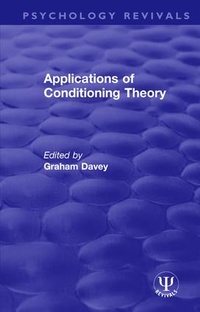
Applications of Conditioning Theory
1st Edition
Published on 21. May 2019
Book
Paperback/Softback
242 pages
978-1-138-57494-6 (ISBN)
Description
The area of applied psychology known as behaviour modification or behaviour therapy had progressed remarkably in the ten years, prior to publication. Illustrative of this progress is the variety of therapeutic and behaviour management techniques now available to the applied psychologist. This volume, originally published in 1981, describes some of the important characteristics of this development, and in particular, the relationship between behaviour change techniques and the principles of conditioning theory that generated them.
This brief gives rise to three main themes. First, the book describes some of the reasons underlying the adoption of the conditioning paradigm and the epistemological advantages of the paradigm for behaviour modification. Second, a number of chapters discuss the current trends in specific areas of applied psychology where conditioning principles play an important heuristic role. These chapters deal with the uses made of conditioning theory in the areas of mental handicap, psychiatric therapy, work organizations, and the treatment of brain injury. Third, later chapters discuss some of the more recent theoretical developments in the field of behaviour modification/therapy, in particular the drift from strict behaviouristic applications of conditioning principles to more cognitive ones.
This brief gives rise to three main themes. First, the book describes some of the reasons underlying the adoption of the conditioning paradigm and the epistemological advantages of the paradigm for behaviour modification. Second, a number of chapters discuss the current trends in specific areas of applied psychology where conditioning principles play an important heuristic role. These chapters deal with the uses made of conditioning theory in the areas of mental handicap, psychiatric therapy, work organizations, and the treatment of brain injury. Third, later chapters discuss some of the more recent theoretical developments in the field of behaviour modification/therapy, in particular the drift from strict behaviouristic applications of conditioning principles to more cognitive ones.
More details
Series
Language
English
Place of publication
London
United Kingdom
Publishing group
Taylor & Francis Ltd
Target group
College/higher education
Professional and scholarly
Dimensions
Height: 216 mm
Width: 138 mm
Weight
450 gr
ISBN-13
978-1-138-57494-6 (9781138574946)
Copyright in bibliographic data and cover images is held by Nielsen Book Services Limited or by the publishers or by their respective licensors: all rights reserved.
Schweitzer Classification
Other editions
Additional editions
Graham Davey
Applications of Conditioning Theory
E-Book
11/2017
Routledge
€47.49
Available for download
Graham Davey
Applications of Conditioning Theory
E-Book
11/2017
Routledge
€47.49
Available for download
Graham Davey
Applications of Conditioning Theory
Book
10/2017
1st Edition
Routledge
€187.00
Shipment within 10-20 days
Person
Content
Notes on the contributors. Editor's Introduction. 1. The Experimental Analysis of Behaviour and its Relevance to Applied Psychology Derek Blackman 2. Applied Behaviour Analysis: Intervention with Retarded People Laurence Tennant, Chris Cullen and John Hattersley 3. The Token Economy Alan Kazdin 4. Application of Behaviour Modification in the Treatment of Traumatically Brain-Injured Adults Rodger Wood and Peter Eames 5. Behaviour Modification in Organizations Graham Davey 6. Pavlovian Principles and Behaviour Therapy Glyn Thomas and Mark O'Callaghan 7. Establishing Behaviour: The Constructional Approach Chris Cullen, John Hattersley and Laurence Tennant 8. Self-Instructional Training and Cognitive Behaviour Modification: A Behavioural Analysis Fergus Lowe and Peter Higson 9. Conditioning Principles, Behaviourism and Behaviour Therapy Graham Davey. Name Index. Subject Index.