

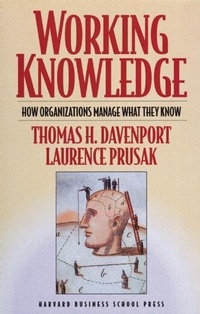
Working Knowledge
How Organizations Manage What They Know
Will be published approx. on 26. April 2000
Book
Paperback/Softback
224 pages
978-1-57851-301-7 (ISBN)
Description
This influential book establishes the enduring vocabulary and concepts in the burgeoning field of knowledge management. It serves as the hands-on resource of choice for companies that recognize knowledge as the only sustainable source of competitive advantage going forward. Drawing from their work with more than thirty knowledge-rich firms, Davenport and Prusak--experienced consultants with a track record of success--examine how all types of companies can effectively understand, analyze, measure, and manage their intellectual assets, turning corporate wisdom into market value. They categorize knowledge work into four sequential activities--accessing, generating, embedding, and transferring--and look at the key skills, techniques, and processes of each. While they present a practical approach to cataloging and storing knowledge so that employees can easily leverage it throughout the firm, the authors caution readers on the limits of communications and information technology in managing intellectual capital.
More details
Edition
Revised edition
Language
English
Place of publication
United States
Product notice
Paperback (trade)
Illustrations
Illustrations
Dimensions
Height: 233 mm
Width: 156 mm
Thickness: 20 mm
Weight
262 gr
ISBN-13
978-1-57851-301-7 (9781578513017)
Copyright in bibliographic data and cover images is held by Nielsen Book Services Limited or by the publishers or by their respective licensors: all rights reserved.
Schweitzer Classification
Persons
Thomas H. Davenport is the President's Distinguished Chair at Babson College and a research fellow at the MIT Center for Digital Business. He is the author of the worldwide bestseller, Process Innovation (HBS Press, 1993) and Mission Critical (HBS Press, 2000). Laurence Prusak is a managing principal of the IBM Consulting Group in Boston and the worldwide competency leader in knowledge management for IBM. He formerly was a researcher/consultant at Ernst & Young and Mercer Management Consulting.
Content
Acknowledgments Introduction 1. What Do We Talk about When We Talk about Knowledge 2. The Promise and Challenge of Knowledge Management 3. Knowledge Generation 4. Knowledge Codification and Coordination 5. Knowledge Transfer 6. Knowledge Roles: The Chief Knowledge Officer and Beyond 7. Technologies for Knowledge Management 8 Knowledge Management Projects in Practice 9. The Pragmatics of Knowledge Management Notes Index About the Authors