

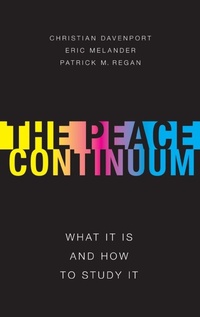
The Peace Continuum
What It Is and How to Study It
Published on 19. July 2018
Book
Hardback
240 pages
978-0-19-068012-1 (ISBN)
Description
The idea of studying peace - over studying war, genocide and political violence (hereafter violent conflict) and then inferring about peace - has gained considerable traction in the past few years after languishing in the shadows of conflict for decades but how should it be studied? The Peace Continuum offers a parallax view of how we think about peace and the complexities that surround the concept (i.e., the book explores the topic from different positions at the same time). Toward this end, we review existing literature and provide insights into how peace should be conceptualized - particularly as something more interesting than the absence of conflict. We provide an approach that can help scholars overcome what we see as the initial shock that comes with unpacking the 'zero' in the war-peace model of conflict studies. Additionally, we provide a framework for understanding how peace and conflict have/have not been related to one another in the literature. To reveal how the Peace Continuum could be applied, we put forward three alternative ways that peace could be studied. With this approach, the book is less trying to control the emerging peace research agenda than it is trying to assist in/encourage thinking about the topic that we all have some opinion on but that has yet to be measured and analyzed in a way comparable to political conflict and violence. Indeed, we attempt to help facilitate a veritable explosion of approaches and efforts to study peace.
More details
Series
Language
English
Place of publication
New York
United States
Target group
College/higher education
Professional and scholarly
Dimensions
Height: 240 mm
Width: 161 mm
Thickness: 18 mm
Weight
531 gr
ISBN-13
978-0-19-068012-1 (9780190680121)
Copyright in bibliographic data and cover images is held by Nielsen Book Services Limited or by the publishers or by their respective licensors: all rights reserved.
Schweitzer Classification
Other editions
Additional editions
Christian Davenport | Erik Melander | Patrick Regan
The Peace Continuum
What It Is and How to Study It
Book
07/2018
Oxford University Press Inc
€47.80
Shipment within 15-20 days
Christian Davenport | Erik Melander | Patrick M. Regan
The Peace Continuum
What It Is and How to Study It
E-Book
06/2018
1st Edition
OUP eBook
€19.99
Available for download
Christian Davenport | Erik Melander | Patrick M. Regan
The Peace Continuum
What It Is and How to Study It
E-Book
06/2018
1st Edition
OUP eBook
€19.99
Available for download
Persons
Christian Davenport is a Professor of Political Science and Faculty Associate at the Center for Political Studies - Institute for Social Research at the University of Michigan as well as Global Fellow and Research Professor at the Peace Research Institute Oslo.
Erik Melander is a Professor at the Department of Peace and Conflict Research and Director of the Uppsala Conflict Data Program (UCDP), at Uppsala University, Sweden.
Professor at the University of Notre Dame. Researches the impact of climate change and social adaptation on armed conflict.
Erik Melander is a Professor at the Department of Peace and Conflict Research and Director of the Uppsala Conflict Data Program (UCDP), at Uppsala University, Sweden.
Professor at the University of Notre Dame. Researches the impact of climate change and social adaptation on armed conflict.
Content
Introduction
Chapter 2 - Contemporary Studies of Peace
Chapter 3 - A Perceptual Approach to Quality Peace
Chapter 4 - A Procedural Approach to Quality Peace
Chapter 5 - A Relational Approach to Quality Peace
Chapter Six: Concluding Observations
References
Chapter 2 - Contemporary Studies of Peace
Chapter 3 - A Perceptual Approach to Quality Peace
Chapter 4 - A Procedural Approach to Quality Peace
Chapter 5 - A Relational Approach to Quality Peace
Chapter Six: Concluding Observations
References