

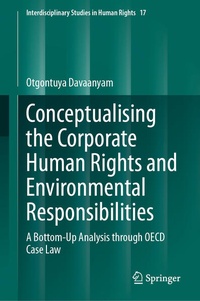
Conceptualising the Corporate Human Rights and Environmental Responsibilities
Description
More details
Other editions
Additional editions
Person
Otgontuya Davaanyam is a Business and Human Rights scholar and postdoctoral researcher at the Centre for Human Rights Erlangen-Nürnberg (CHREN), Friedrich-Alexander-Universität Erlangen-Nürnberg (FAU). Her research focuses on corporate accountability, remedy, and responsible business conduct (RBC), drawing on OECD National Contact Point case law and issues of human rights due diligence, environmental responsibility, and access to remedy. She holds degrees in law from Shihihutug University, the University of Liverpool, and Swansea University. Her professional background spans legal practice, international development, and applied research. She has worked as an attorney at Anderson & Anderson LLP, consulted for UNDP Mongolia on business and human rights, and contributed to policy and advocacy efforts with the Business & Human Rights Resource Centre, OHCHR, and FiftyEight. She is also the co-editor of the open-access book Exploring Corporate Human Rights Responsibilities in OECD Case Law and co-author for the National Baseline Assessment for Business and Human Rights Mongolia for the Mongolian Government and UNDP cooperated 'NAP on Business and Human Rights' project. She has received the Hodgson Law Scholarship and the Hillary Rodham Clinton Global Challenges Scholarship. Currently, she is expanding her research into the lived experiences of Mongolian nomadic herders, exploring the impacts of mining, just transition, and corporate responsibility on land, culture, and Indigenous women.
Content
Chapter 1: Introduction.- Chapter 2: Analysing Corporate Human Rights Responsibilities Through the Lens of the UN Guiding Principles and OECD Case Law.- Chapter 3: Clarifying Corporate Human Rights Responsibilities in Specific Contexts through OECD Case Law.- Chapter 4: Clarifying Corporate Human Rights Responsibilities Considering Different Corporate Actors through OECD Case Law.- Chapter 5: Conclusion - From Soft Law to Influence: The Normative Authority of OECD NCP Statements In Shaping Corporate Responsibility.