

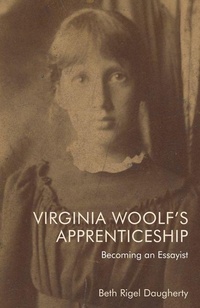
Virginia Woolf's Apprenticeship
Becoming an Essayist
199th Edition
Published on 6. July 2022
Book
Hardback
432 pages
978-1-3995-0451-5 (ISBN)
Description
This study takes up Woolf's challenge to probe the relationship between education and work, specifically her education and her work as an essayist. It expands her education beyond her father's library to include not only a broader examination of her homeschooling but also her teaching at Morley College and her early book reviewing. It places Virginia Stephen's learning in the historical and cultural contexts of education for women, the working classes and writers in the late nineteenth and early twentieth century.
Weaving together Virginia Stephen's homeschooling, her teaching and her writing for the newspapers, Beth Rigel Daugherty demonstrates how these three strands shape Virginia Woolf's essay persona, her essays and her relationship with her readers. She also shows why Virginia Stephen's apprenticeship compels Virginia Woolf to become a pedagogical essayist. The volume publishes two holograph draft lectures by Virginia Stephen for the first time and mines rarely used archival materials. It also includes five appendices, one detailing Virginia Stephen's library and another her apprenticeship essays.
This is the first in a two-volume study of Virginia Woolf's essays that analyses Virginia Stephen's development and Virginia Woolf's achievements as an essay writer.
Weaving together Virginia Stephen's homeschooling, her teaching and her writing for the newspapers, Beth Rigel Daugherty demonstrates how these three strands shape Virginia Woolf's essay persona, her essays and her relationship with her readers. She also shows why Virginia Stephen's apprenticeship compels Virginia Woolf to become a pedagogical essayist. The volume publishes two holograph draft lectures by Virginia Stephen for the first time and mines rarely used archival materials. It also includes five appendices, one detailing Virginia Stephen's library and another her apprenticeship essays.
This is the first in a two-volume study of Virginia Woolf's essays that analyses Virginia Stephen's development and Virginia Woolf's achievements as an essay writer.
Reviews / Votes
A great part of the pleasure of reading Virginia Woolf's Apprenticeship is the knowledge that Daugherty brings to bear on Woolf's early life through the beginning of her career. -- Jeanne Dubino, Appalachian State University * Virginia Woolf Miscellany * Drawing on deep research into the social history of women's lives and of education, Daugherty shows with superb attention to detail how Virginia Stephen's early experiences of teaching and of being taught nourished the seeds that flowered as Virginia Woolf, "an essayist compelled to teach." This is impeccable and important scholarship. -- Mark Hussey, Distinguished Professor Emeritus, Pace University [The book is] an invaluable resource for scholars - not only for Woolf specialists, but also for anyone interested in the broader historical context of women's education or working-class education in Britain in the late nineteenth and early twentieth centuries. -- Mitchell Alcrim * Literature Cambridge * This electrifying magnum opus illuminates Virginia Woolf's formative experience of teaching working-class adult students while starting her own career as a freelance book reviewer. Beth Rigel Daugherty shows how helping and identifying with novice learners influenced Woolf's nonfiction aesthetic. Over many subsequent years, Woolf made a striking attempt to write essays in ways that would welcome ordinary readers.Virginia Woolf's Apprenticeship launches a new era in the way Woolf is assessed and will stimulate scholars, teachers, and writers in the broad and burgeoning genre of creative nonfiction. Deeply researched historically and biographically, it contributes beyond Woolf studies to the fields of memoir, personal essay, journalism, and pedagogy. Warm of manner and lively of style, it has a bold and ambitious purpose: to help us see Virginia Woolf anew as a working, learning, growing person and writer. Woolf emerges as someone deeply concerned with connecting with others regardless of their class and gender, thereby attempting to transcend the limits of her family, her heritage, and her time. Showing this is the book's larger, remarkable achievement. -- Richard Gilbert, MFA, nonfiction author, teacher, and publisher Marked by impeccable scholarship, this is the only full-length study of Woolf's acquisition of knowledge prior to her marriage. -- Valerie Murrenus Pilmaier, University of Wisconsin-Green Bay * CHOICE *
More details
Edition
199,647 edition
Language
English
Place of publication
Edinburgh
United Kingdom
Target group
College/higher education
Product notice
sewn/stitched
Cloth over boards
Illustrations
6 black and white illustrations
Dimensions
Height: 234 mm
Width: 156 mm
Thickness: 25 mm
Weight
794 gr
ISBN-13
978-1-3995-0451-5 (9781399504515)
Copyright in bibliographic data and cover images is held by Nielsen Book Services Limited or by the publishers or by their respective licensors: all rights reserved.
Schweitzer Classification
Other editions
Additional editions
E-Book
07/2022
1st Edition
Edinburgh University Press
€165.99
Available for download
E-Book
07/2022
1st Edition
Edinburgh University Press
€165.99
Available for download
Person
Recently retired from Otterbein University in Ohio, Beth Rigel Daugherty taught modernist English literature, Virginia Woolf and Appalachian and Native American literature along with many thematically focused writing courses for 36 years. Falling in love with Virginia Woolf and her essays while at Rice University, she has been presenting and publishing on both ever since with peer-reviewed articles in edited collections; editions of the "How Should Read a Book?" holograph draft and Woolf's fan letters in Woolf Studies Annual; and, with Mary Beth Pringle, the Modern Language Association teaching volume on To the Lighthouse.
Content
Acknowledgements
Introduction
Part One: Student, 1882-1904: Learning at Home
1. Learning at 22 Hyde Park Gate
2. Coming into 22 Hyde Park Gate
3. Venturing beyond 22 Hyde Park Gate
4. Reading and Writing Skills
5. Outcomes: Learning at Home
Part Two: Teacher, 1905-1907: Teaching at Morley College
6. Teaching at Morley College
7. Learning from Morley College
8. Teaching Skills
9. Outcomes: Teaching at Morley College
Part Three: Apprentice, 1904-1912: Writing for Newspapers
10. Becoming a Professional
11. Learning from Editors
12. Essay Writing and Book Reviewing Skills
13. Outcomes: Writing for Newspapers
Conclusion
Appendix 1 Virginia Stephen's King's College for Ladies Class Schedule
Appendix 2 Virginia Stephen's Library
Appendix 3 Virginia Stephen's Morley College Teaching Schedule
Appendix 4 Virginia Stephen's Lectures
Appendix 5 Virginia Stephen's Reviews and Essays
Index
Introduction
Part One: Student, 1882-1904: Learning at Home
1. Learning at 22 Hyde Park Gate
2. Coming into 22 Hyde Park Gate
3. Venturing beyond 22 Hyde Park Gate
4. Reading and Writing Skills
5. Outcomes: Learning at Home
Part Two: Teacher, 1905-1907: Teaching at Morley College
6. Teaching at Morley College
7. Learning from Morley College
8. Teaching Skills
9. Outcomes: Teaching at Morley College
Part Three: Apprentice, 1904-1912: Writing for Newspapers
10. Becoming a Professional
11. Learning from Editors
12. Essay Writing and Book Reviewing Skills
13. Outcomes: Writing for Newspapers
Conclusion
Appendix 1 Virginia Stephen's King's College for Ladies Class Schedule
Appendix 2 Virginia Stephen's Library
Appendix 3 Virginia Stephen's Morley College Teaching Schedule
Appendix 4 Virginia Stephen's Lectures
Appendix 5 Virginia Stephen's Reviews and Essays
Index