

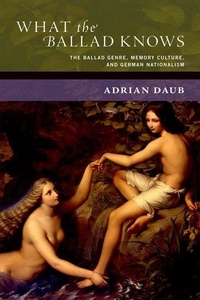
What the Ballad Knows
The Ballad Genre, Memory Culture, and German Nationalism
Published on 14. November 2022
Book
Hardback
296 pages
978-0-19-088549-6 (ISBN)
Description
Over the course of the 19th century, ballads proliferated in German-speaking Europe in a truly remarkable range of contexts. Audiences were of course likely encounter balladry in the volumes of Goethe and Schiller, in various anthologies or illustrated editions. But they were just as likely to come across objects billed as ballads in recitation evenings by popular actors, in song-settings by Schubert and Loewe, in piano pieces by Chopin, in the opera house and the concert hall, in mass-produced drawings, paintings and even chinaware. Ballads were poems one could use - schoolteachers used them to train their students' memory (or punish them), women composers used them to assert their place in the musical canon, actors used them to bolster their income, mothers used them to put their children to sleep. Ballads intersected with gender and class, promising to democratize art, while in fact helping make distinctions. In What the Ballad Knows: The Ballad Genre, Memory Culture and German Nationalism, Adrian Daub tells the story of this itinerant genre across media, periods, regions and social strata and shows that, even though it was often positioned as an authentic product of "German spirit," the ballad frequently unsettled and subverted the national project. The popular imagination rooted these poems in pre-modern oral culture, among bards and peasants in the everyday life of common folk. But in fact nineteenth-century ballads were in the end all about modernity - modern modes of association, of attention, of dissemination.
Reviews / Votes
Adrian Daub's brilliant synthesis of the many lives of ballads in German culture breathes new and more complex meaning into Eric Hobsbawm's and Terence Ranger's concept of invented traditions. Daub calls the ballad "poetry one lived with," and his subtle, lucid analysis of its many contexts-travel, family, the schoolroom, the public sphere, the national imaginary-sketches a great arc of continuity in German life. It is erudite, graceful, and wise-a major achievement. * Celia Applegate, William R. Kenan, Jr. Professor of History, Professor of Musicology and Ethnomusicology, Professor of German, Russian, and European Studies, Vanderbilt University * Readers with interests in lyric generally, in poetry and nationalism, and in poetry and music will learn a great deal from this beautifully written, wide ranging, and illuminating volume. * Hannah Vandegrift, Monatshefte * This volume will be valuable for scholars of German literature and music history. * Choice * What the Ballad Knows enacts an exemplary mission of recovery for a repertory that has enjoyed less eminence than its cousin, the lied. It will surely engender many followers, and possibly many epigones too. * Philip Ross Bullock, Wadham College, University of Oxford *More details
Series
Language
English
Place of publication
New York
United States
Target group
Professional and scholarly
Product notice
sewn/stitched
Cloth over boards
Illustrations
15 halftones
Dimensions
Height: 237 mm
Width: 163 mm
Thickness: 24 mm
Weight
576 gr
ISBN-13
978-0-19-088549-6 (9780190885496)
Copyright in bibliographic data and cover images is held by Nielsen Book Services Limited or by the publishers or by their respective licensors: all rights reserved.
Schweitzer Classification
Other editions
Additional editions
E-Book
08/2022
OUP eBook
€43.49
Available for download
E-Book
08/2022
OUP eBook
€43.49
Available for download
Person
Adrian Daub is Professor of German Literature and Comparative Literature at Stanford University and author of Uncivil Unions: The Metaphysics of Marriage in German Idealism and Romanticism (2012), Four-Handed Monsters: Four-Hand Piano Playing and Nineteenth-Century Culture (OUP, 2014), and The Dynastic Imagination: Family and Modernity in Nineteenth Century Germany (2020). He is co-author with Charles Kronengold of The James Bond Songs: Pop Anthems of Late Capitalism (OUP, 2015).
Content
Introduction: What the Ballad Knows
Chapter 1: The Ballad's Years of Travel: The Musenalmanach for 1798, Orality, and the Ballad Form
Chapter 2: The Ballad, The Voice and the Echoes of War
Chapter 3: Balladic Consciousness: The Ballad on the Opera Stage
Chapter 4: Memorizing Ballads: Pedagogy, Tradition and the Open Secret
Chapter 5: The Ballad and the Family
Chapter 6: The Ballad and Its Narratives
Chapter 7: The Ballad, the Public and Gendered Community
Chapter 8: The Ballad and the Sea: Regionalism, Mourning and the Modern National Imaginary
Epilogue: The Ballad as Record
Acknowledgments
Index
Chapter 1: The Ballad's Years of Travel: The Musenalmanach for 1798, Orality, and the Ballad Form
Chapter 2: The Ballad, The Voice and the Echoes of War
Chapter 3: Balladic Consciousness: The Ballad on the Opera Stage
Chapter 4: Memorizing Ballads: Pedagogy, Tradition and the Open Secret
Chapter 5: The Ballad and the Family
Chapter 6: The Ballad and Its Narratives
Chapter 7: The Ballad, the Public and Gendered Community
Chapter 8: The Ballad and the Sea: Regionalism, Mourning and the Modern National Imaginary
Epilogue: The Ballad as Record
Acknowledgments
Index