

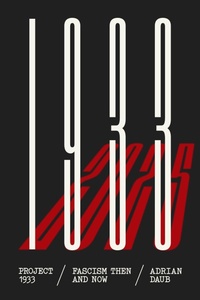
Project 1933
Fascism Then and Now
Will be published approx. on 12. January 2027
Book
Hardback
224 pages
978-1-6626-0368-6 (ISBN)
Description
For readers of Jason Stanley and Timothy Snyder comes an urgent and rigorous comparison of our current political climate to that of Germany's during Hitler’s first year in power.
Since a new wave of far right-wing sentiment entered American political life a decade ago, political scientists and pundits have chided people for what they see as overly facile comparisons between today’s Republican leadership and Nazism. Are these comparisons just scare-mongering? Or could they tell us something useful about the state of American democracy?
Using the writings of German thinkers like Thomas Mann, Victor Klemperer, Hannah Arendt, and other meticulous diarists of the era, Project 1933 retells the story of the first year of the Third Reich month-by-month, pausing to draw connections between Germany’s past and America’s present. Adrian Daub deftly explores the truths of living under fascism—the grim uncertainty (and even grimmer certainty) of early days, the existential scramble to cleave to institutions that define us even as they are bent to the will of a despot, the creation of bystanders and collaborators, the shifting cultural conversations, and the day-to-day banalities.
While some parallels are downright terrifying, Project 1933 aims to remind readers of the choices that are available to us, and that fascism’s key magic trick is to convince us of its own inevitability. Project 1933 shows readers a path toward a more hopeful, moral imagination and the possibility of radical change.
Since a new wave of far right-wing sentiment entered American political life a decade ago, political scientists and pundits have chided people for what they see as overly facile comparisons between today’s Republican leadership and Nazism. Are these comparisons just scare-mongering? Or could they tell us something useful about the state of American democracy?
Using the writings of German thinkers like Thomas Mann, Victor Klemperer, Hannah Arendt, and other meticulous diarists of the era, Project 1933 retells the story of the first year of the Third Reich month-by-month, pausing to draw connections between Germany’s past and America’s present. Adrian Daub deftly explores the truths of living under fascism—the grim uncertainty (and even grimmer certainty) of early days, the existential scramble to cleave to institutions that define us even as they are bent to the will of a despot, the creation of bystanders and collaborators, the shifting cultural conversations, and the day-to-day banalities.
While some parallels are downright terrifying, Project 1933 aims to remind readers of the choices that are available to us, and that fascism’s key magic trick is to convince us of its own inevitability. Project 1933 shows readers a path toward a more hopeful, moral imagination and the possibility of radical change.
More details
Language
English
Place of publication
United States
Publishing group
Astra Publishing House
Product notice
Paperback (trade)
Dimensions
Height: 210 mm
Width: 140 mm
Weight
567 gr
ISBN-13
978-1-6626-0368-6 (9781662603686)
Copyright in bibliographic data and cover images is held by Nielsen Book Services Limited or by the publishers or by their respective licensors: all rights reserved.
Schweitzer Classification
Person
Adrian Daub is a critic, the J.E. Wallace Sterling Professor in the Humanities and director of the Clayman Institute for Gender Research at Stanford University, and podcast host based in San Francisco, CA. His writing about politics, literature, culture, and academia has appeared in n+1, The Guardian, The Nation, and LARB. He is the author of What Tech Calls Thinking and The Cancel Culture Panic.