

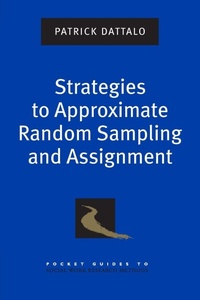
Strategies to Approximate Random Sampling and Assignment
Published on 12. November 2009
Book
Paperback/Softback
216 pages
978-0-19-537835-1 (ISBN)
Description
Random sampling and random assignment are considered by many researchers to be the definitive methodological procedures for maximizing external and internal validity. However, there is a daunting list of legal, ethical, and practical barriers to implementing random sampling and random assignment. While there are no easy ways to overcome these barriers, social workers should seek and utilize strategies that minimize sampling and assignment bias. These methodological and statistical strategies form the book's core.
In step-by-step chapters liberally illustrated with examples using a variety of software packages, Dattalo guides readers in selecting and implementing an appropriate strategy. Readers will gain confidence in using such techniques as exemplar sampling, sequential sampling, randomization tests, multiple imputation, mean-score logistic regression, partial randomization, constructed comparison groups, instrumental variables methods, and propensity scores. Each approach will be cataloged in such a way as to highlight its underlying assumptions, implementation strategies, and strengths and weaknesses.
Screen shots, annotated resources, and a companion website make this a valuable tool for students, teachers, and researchers seeking a single source that provides a diverse set of tools that will maximize a study's validity when random sampling and random assignment are neither possible nor practical.
In step-by-step chapters liberally illustrated with examples using a variety of software packages, Dattalo guides readers in selecting and implementing an appropriate strategy. Readers will gain confidence in using such techniques as exemplar sampling, sequential sampling, randomization tests, multiple imputation, mean-score logistic regression, partial randomization, constructed comparison groups, instrumental variables methods, and propensity scores. Each approach will be cataloged in such a way as to highlight its underlying assumptions, implementation strategies, and strengths and weaknesses.
Screen shots, annotated resources, and a companion website make this a valuable tool for students, teachers, and researchers seeking a single source that provides a diverse set of tools that will maximize a study's validity when random sampling and random assignment are neither possible nor practical.
More details
Series
Language
English
Place of publication
New York
United States
Target group
Professional and scholarly
Dimensions
Height: 210 mm
Width: 140 mm
Thickness: 12 mm
Weight
266 gr
ISBN-13
978-0-19-537835-1 (9780195378351)
Copyright in bibliographic data and cover images is held by Nielsen Book Services Limited or by the publishers or by their respective licensors: all rights reserved.
Schweitzer Classification
Other editions
Additional editions
Patrick Dattalo
Strategies to Approximate Random Sampling and Assignment
E-Book
10/2009
OUP eBook
€18.99
Available for download
Person
Patrick Dattalo, Ph.D. is an Associate Professor in the School of Social Work at Virginia Commonwealth University.
Content
1. Basic Concepts, Organization of Book, and Assumptions ; 2. Methodological Alternatives and Supplements to Random Sampling ; 3. Statistical Alternatives and Supplements to Random Sampling ; 4. Methodological Alternatives and Supplements to Random Assignment ; 5. Alternatives and Complementary Strategies to Random Assignment ; 6. Summary and Conclusions ; Annotated Bibliography ; References