

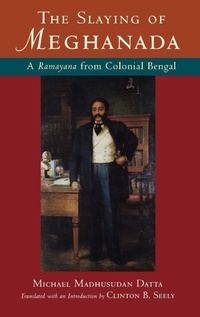
The Slaying of Meghanada
A Ramayana from Colonial Bengal
Published on 22. April 2004
Book
Hardback
288 pages
978-0-19-516799-3 (ISBN)
Description
"The poem is rising into splendid popularity. Some say it is better than Milton-but that is all bosh-nothing can be better than Milton; many say it licks Kalidasa; I have no objection to that. I don't think it impossible to equal Virgil, Kalidasa, and Tasso." Michael Madhusudan Datta wrote this in a letter to a friend about his verse narrative, The Slaying of Meghanada (1861). The epic, a Bengali version of the Ramayana story in which Ravana, not Rama, is the hero, has become a classic of Indian literature. Datta lived in Bengal at the height of what is frequently called the Bengal Renaissance, a time so labeled for its reinvigoration and reconfiguration of the Hindu past and for the florescence of the literary arts. It was also a period when the Bengali city of Kolkata was a center of world trade-the second city of the British empire-and thus a site of cultural exchange between India and the West. Datta was the perfect embodiment of this time and place. The Slaying of Meghanada is deeply influenced by western epic tradition, and is sprinkled with nods to Homer, Milton, and Dante. Datta's deft intermingling of western and eastern literary traditions brought about a sea change in South Asian literature, and is generally considered to mark the dividing line between pre-modern and modern Bengali literature. Datta's masterpiece is now accessible to readers of English in Clinton Seely's elegant translation, which captures both the sense and the spirit of the original. The poem is supplemented by an extensive introduction, notes, and a glossary.
Reviews / Votes
"This is a landmark book, indispensable to students of literature and modernity in colonial South Asia. It consolidates Seely's reputation as one of the finest contemporary translators of Bengali into English. A truly remarkable achievement."--Dipesh Chakrabarty, University of Chicago "Segments of the narrative of the Ramayana frequently mutate into variant versions and each retelling reflects an adaptation to yet another language, another community and another historical moment. The Meghanadavadha kavya captures some intersections of Indian and European cultures in the nineteenth century. Clinton Seely's translation evokes the potential of this historical moment and also of the epic genre, both of which resonate with the perceptions of Michael Madhusudan Datta."--Romila Thapar, Jawaharlal Nehru University "This book is a polished gem, a sparkling gift of translation and contextualization from Clinton B. Seely--legendary teacher, speaker, and translator--to all students of Bengal, colonial history, Ramayana studies, and Indian literature. The Slaying of Meghanada, Seely's artistic rendition of Michael Madhusudan Datta's classic Bengali version of the Ramayana, invites us to understand and feel, with Datta and through Seely, the particularly Bengali pathos of a doomed, humanized, agonized Ravana. Here is a text for our times, where Rama is not the hero.--Rachel Fell McDermott, Asian and Middle Eastern Cultures, Barnard CollegeMore details
Language
English
Place of publication
New York
United States
Target group
Professional and scholarly
Dimensions
Height: 240 mm
Width: 161 mm
Thickness: 20 mm
Weight
593 gr
ISBN-13
978-0-19-516799-3 (9780195167993)
Copyright in bibliographic data and cover images is held by Nielsen Book Services Limited or by the publishers or by their respective licensors: all rights reserved.
Schweitzer Classification
Other editions
Additional editions
E-Book
03/2004
1st Edition
OUP eBook
€30.49
Available for download
Persons
Clinton B. Seely is Professor in the Department of South Asian Languages and Civilizations at the University of Chicago. He is the author of A Poet Apart: A Literary Biography of the Bengali Poet Jibanananda Das, 1899-1954 (1990) and several other books.