

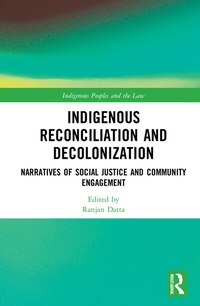
Indigenous Reconciliation and Decolonization
Narratives of Social Justice and Community Engagement
1st Edition
Published on 30. December 2020
Book
Hardback
182 pages
978-0-367-48663-1 (ISBN)
Description
This book addresses the ethical and practical issues at stake in the reconciliation of Indigenous and non-indigenous communities.
An increasing number of researchers, educators, and social and environmental activists are eager to find ways to effectively support ongoing attempts to recognize, integrate and promote Indigenous perspectives and communities. Taking Canada as its focus, this book offers a multidisciplinary consideration of a range of reconciliation policies, practices and initiatives that are relevant in all settler states. Set against its increasing neoliberal appropriation, the book resituates reconciliation in the everyday contexts of community interaction and engagement, as well as in the important areas of Indigenous knowledge, resource management and social and environmental justice. Reconciliation is not just the responsibility of law and government. And, attuned to the different perspectives of settlers, migrants and refugee communities, the book examines areas of opportunity, as well as obstacles to progress, in the forging of a truly decolonizing framework for reconciliation.
As the challenges of reconciliation cross numerous academic and substantial areas, this book will appeal to a range of scholars and practitioners working in law, politics, education, environmental studies, anthropology and Indigenous studies.
An increasing number of researchers, educators, and social and environmental activists are eager to find ways to effectively support ongoing attempts to recognize, integrate and promote Indigenous perspectives and communities. Taking Canada as its focus, this book offers a multidisciplinary consideration of a range of reconciliation policies, practices and initiatives that are relevant in all settler states. Set against its increasing neoliberal appropriation, the book resituates reconciliation in the everyday contexts of community interaction and engagement, as well as in the important areas of Indigenous knowledge, resource management and social and environmental justice. Reconciliation is not just the responsibility of law and government. And, attuned to the different perspectives of settlers, migrants and refugee communities, the book examines areas of opportunity, as well as obstacles to progress, in the forging of a truly decolonizing framework for reconciliation.
As the challenges of reconciliation cross numerous academic and substantial areas, this book will appeal to a range of scholars and practitioners working in law, politics, education, environmental studies, anthropology and Indigenous studies.
More details
Series
Language
English
Place of publication
London
United Kingdom
Publishing group
Taylor & Francis Ltd
Target group
College/higher education
Illustrations
2 s/w Abbildungen, 2 s/w Photographien bzw. Rasterbilder
2 Halftones, black and white; 2 Illustrations, black and white
Dimensions
Height: 234 mm
Width: 156 mm
Weight
980 gr
ISBN-13
978-0-367-48663-1 (9780367486631)
Copyright in bibliographic data and cover images is held by Nielsen Book Services Limited or by the publishers or by their respective licensors: all rights reserved.
Schweitzer Classification
Other editions
Additional editions
Ranjan Datta
Indigenous Reconciliation and Decolonization
Narratives of Social Justice and Community Engagement
Book
08/2022
1st Edition
Routledge
€65.00
Shipment within 15-20 days
Ranjan Datta
Indigenous Reconciliation and Decolonization
Narratives of Social Justice and Community Engagement
E-Book
12/2020
1st Edition
Routledge
€59.49
Available for download
Ranjan Datta
Indigenous Reconciliation and Decolonization
Narratives of Social Justice and Community Engagement
E-Book
12/2020
1st Edition
Routledge
€59.49
Available for download
Person
Ranjan Datta is Canada Research Chair-II at the Department of Humanities at Mount Royal University, Calgary, Canada.
Content
1. Introduction Ranjan Datta. Part One: Meanings of Reconciliation. 2. Reconciliation as Decolonizing Ceremony Ranjan Datta. 3. Turtle Island to Babylon Ahmad Majid. 4. This Reconciliation is for the Colonizer Andrea Landry. 5. Language and Reconciliation: An Indigenous Woman's Perspective Edie Venne. 6. The Trapline: A Pathway of Indigenous Land-based Reconciliation Colleen Charles. Part Two: Responsibilities for Land and Reconciliation. 7. Reconciliation through Kits and Tests? Reconsidering Newcomer Responsibilities on Indigenous Land Nisha Toomey, Yi Chien Jade Ho, Deanna Del Vecchio with Eve Tuck. 8. Theorizing Land, Responsibility and Reconciliation through Black Women standpoint Njoki Wane and Hermia Anthony. 9. Reconciliation as Rationalization of State Violence: Activist Performance as Resistance to TRC politics in Chile and Canada Manuela Valle-Castro. 10. Embracing reconciliation in the face of adversity: An intersectional perspective on land, immigration, and anti-racist learning Jada Renee Koushik and Naomi Mumbi Maina-Okori. 11. Indigenous and Newcomer Women in Journeys of Reconciliation: Building Relationships and Learning from One Another Judy White. 12. Building Bridges among Indigenous and Immigrant Communities: A Visible Minority Immigrant Woman's Journey Jebunnessa Chapola. 13. Humanizing Community-engaged Participatory Research through Relational Practice Carolyn M. Gaspar and Clifford T. Ballantyne. 14. Reflecting on the Privilege of the Canadian Treaties Margot A. Hurlbert. Part Three: How to Move Forward. 15. Conclusion: Reconciliation as Taking Responsibilities.