

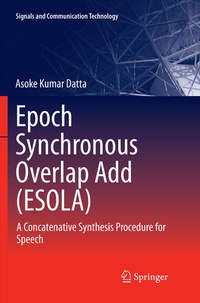
Epoch Synchronous Overlap Add (ESOLA)
A Concatenative Synthesis Procedure for Speech
Published on 23. December 2018
Book
Paperback/Softback
XII, 197 pages
978-981-13-4986-7 (ISBN)
Description
This book presents details of a text-to-speech synthesis procedure using epoch synchronous overlap add (ESOLA), and provides a solution for development of a text-to-speech system using minimum data resources compared to existing solutions. It also examines most natural speech signals including random perturbation in synthesis. The book is intended for students, researchers and industrial practitioners in the field of text-to-speech synthesis.
More details
Series
Edition
Softcover reprint of the original 1st ed. 2018
Language
English
Place of publication
Singapore
Singapore
Target group
Professional and scholarly
Illustrations
56 s/w Abbildungen, 32 farbige Abbildungen
XII, 197 p. 88 illus., 32 illus. in color.
Dimensions
Height: 235 mm
Width: 155 mm
Thickness: 12 mm
Weight
330 gr
ISBN-13
978-981-13-4986-7 (9789811349867)
DOI
10.1007/978-981-10-7016-7
Schweitzer Classification
Other editions
Additional editions
Asoke Kumar Datta
Epoch Synchronous Overlap Add (ESOLA)
A Concatenative Synthesis Procedure for Speech
Book
01/2018
Springer
€53.49
Shipment within 15-20 days
Person
Prof. Asoke Kumar Datta, an MSc. (Pure Math), was born in 1935 and worked in Indian Statistical Institute 1955-1994, retired as HOD Electronics and Communication Sciences Department, Visiting Professor of ISI till date; President, BOM-BOM, Kolkata; Senior Guest Researcher, Sir C V Raman Centre for Physics and Music, JU; Executive Member, Society for Natural Language Technology Research, Kolkata; Life Member, Acoustical Society of India; J C Bose Memorial Award, 1969, Sir C V Raman Award, 1982-83 &1998-99, S K Mitra Memorial Award, 1984, Sri C Achyut Menon Prize, 2001.
Content
Introduction.- Epoch Synchronous Overlap Add (ESOLA) Algorithm.- State Phase Analysis: PDA/VDA Algorithm and Phoneme Classifier.- Phonological Rules.- Intonation.- Random Perturbations.- Application in singing synthesis.