

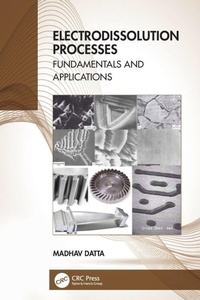
Electrodissolution Processes
Fundamentals and Applications
1st Edition
Published on 25. September 2023
Book
Paperback/Softback
296 pages
978-0-367-40705-6 (ISBN)
Description
Electrodissolution Processes: Fundamentals and Applications discusses the basic principles involved in high-rate anodic dissolution processes and their application in advanced machining, micromachining, and finishing operations. The fundamentals section of the book discusses the anodic dissolution behavior of different classes of metals and the influence of mass transport, current distribution, and surface film properties on the metal removal rate and surface finishing. The applications section of the book presents essential elements of electrochemical and assisted techniques for precision machining, micromachining, and polishing of advanced materials, including hard-to-machine conducting ceramic materials.
Features
A first-of-its-kind book that provides updated scientific and engineering information related to high-rate anodic dissolution processes
Highlights the importance of the understanding of basic principles required for designing and optimizing ECM/EMM/EP processes
Gives equal emphasis to the fundamentals and applications of electrodissolution processes
Discusses the high-rate anodic dissolution of two broad classes of materials, namely, engineering and refractory materials
Presents case studies to demonstrate the capabilities of different electrochemical and assisted machining, micromachining, and finishing operations
Presents a dedicated chapter on electrochemical planarization of copper interconnects
Madhav Datta is the Chairman of Amrita Center for Industrial Research and Innovation and a Distinguished Professor in the Department of Chemical Engineering and Materials Science, Amrita University, Coimbatore, India.
Features
A first-of-its-kind book that provides updated scientific and engineering information related to high-rate anodic dissolution processes
Highlights the importance of the understanding of basic principles required for designing and optimizing ECM/EMM/EP processes
Gives equal emphasis to the fundamentals and applications of electrodissolution processes
Discusses the high-rate anodic dissolution of two broad classes of materials, namely, engineering and refractory materials
Presents case studies to demonstrate the capabilities of different electrochemical and assisted machining, micromachining, and finishing operations
Presents a dedicated chapter on electrochemical planarization of copper interconnects
Madhav Datta is the Chairman of Amrita Center for Industrial Research and Innovation and a Distinguished Professor in the Department of Chemical Engineering and Materials Science, Amrita University, Coimbatore, India.
More details
Language
English
Place of publication
London
United Kingdom
Publishing group
Taylor & Francis Ltd
Target group
College/higher education
Professional and scholarly
Postgraduate and Professional
Illustrations
163 s/w Abbildungen, 11 s/w Tabellen
11 Tables, black and white; 163 Illustrations, black and white
Dimensions
Height: 234 mm
Width: 156 mm
Thickness: 18 mm
Weight
480 gr
ISBN-13
978-0-367-40705-6 (9780367407056)
Copyright in bibliographic data and cover images is held by Nielsen Book Services Limited or by the publishers or by their respective licensors: all rights reserved.
Schweitzer Classification
Other editions
Additional editions
Book
12/2020
1st Edition
CRC Press
€241.40
Shipment within 15-20 days
E-Book
12/2020
1st Edition
CRC Press
€86.99
Available for download
E-Book
12/2020
1st Edition
CRC Press
€86.99
Available for download
Person
Madhav Datta is an R&D professional with extensive experience in academic and industrial research. He received a BS in chemical engineering from H.B. Technological Institute, Kanpur, an MS in chemical engineering from the University of California at Los Angeles, and a PhD from the Materials Department of Ecole Polytechnique Federale de Lausanne (EPFL), Switzerland in 1975. Dr. Datta's affiliations include the Materials Department of EPFL (1973-1984), IBM's T.J. Watson Research Center, Yorktown Heights, New York (1985-1999), Intel's Logic Technology Development, Portland, Oregon (1999-2002); and Emerson Network Power's Cooligy Precision Cooling, Mountain View, California (2003-2013). In 2015, he joined the Coimbatore campus of Amrita Vishwa Vidyapeetham (Amrita University) as the Chairman of Amrita Center for Industrial Research and Innovation and a Distinguished Professor in the Chemical Engineering and Materials Science Department. His research interests include electrochemical dissolution and deposition, and their application in microelectronic packaging, including flip-chip technology, microcooling devices, and electronic materials. For his contribution to electrochemical processing and especially to electrodissolution processes as applied to microfabrication in the electronics industry, he was awarded the Electrodeposition Research Award of the Electrochemical Society in 1998. Dr. Datta is an innovator with 49 issued US Patents. He has over 100 scientific publications to his credit and is the author or editor of several books on electrochemical processing and micro/nanoelectronics. He coedited a series on New Trends in Electrochemical Technology. He has held several administrative positions, including divisional chairs in the Electrochemical Society (ECS) and the International Society of Electrochemistry (ISE). Dr. Datta chaired the Technology Working Group and Technology Implementation Group of National Electronics Manufacturing Initiative (NEMI) and developed a first-of-its-kind technology road map of energy storage systems for the electronics industry.
Content
1. Open-Circuit Metal Dissolution Processes 2. Anodic Behavior of Metals 3. Transpassive Films and Their Breakdown under ECM Conditions 4. Mass Transport and Current Distribution 5. High-Rate Anodic Dissolution of Fe, Ni, Cr, and Their Alloys 6. High-Rate Anodic Dissolution of Ti, W, and Their Carbides 7. Anodic Dissolution of Metals in Electropolishing Electrolytes 8. Electrochemical Machining 9. Electrochemical Micromachining: Maskless Techniques 10. Through-Mask Electrochemical Micromachining 11. Electropolishing in Practice 12. Electrochemical Planarization of Copper Interconnects