

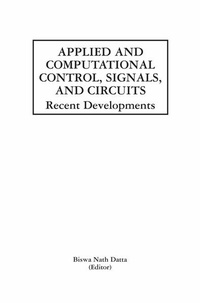
Applied and Computational Control, Signals, and Circuits
Recent Developments
Published on 9. November 2012
Book
Paperback/Softback
XVI, 285 pages
978-1-4613-5570-0 (ISBN)
Description
Applied and Computational Control, Signals, and Circuits: Recent
Developments
is an interdisciplinary book blending mathematics, computational mathematics, scientific computing and software engineering with control and systems theory, signal processing, and circuit simulations. The material consists of seven state-of-the-art review chapters, each written by a leading expert in that field. Each of the technical chapters deals exclusively with some of the recent developments involving applications and computations of control, signals and circuits. Also included is a Chapter focusing on the newly developed Fortran-based software library, called SLICOT, for control systems design and analysis.
This collection will be an excellent reference work for research scientists, practicing engineers, and graduate level students of control and systems, circuit design, power systems and signal processing.
This collection will be an excellent reference work for research scientists, practicing engineers, and graduate level students of control and systems, circuit design, power systems and signal processing.
More details
Series
Edition
Softcover reprint of the original 1st ed. 2001
Language
English
Place of publication
New York
United States
Target group
Professional and scholarly
Research
Illustrations
XVI, 285 p.
Dimensions
Height: 235 mm
Width: 155 mm
Thickness: 17 mm
Weight
464 gr
ISBN-13
978-1-4613-5570-0 (9781461355700)
DOI
10.1007/978-1-4615-1471-8
Schweitzer Classification
Other editions
Additional editions
E-Book
12/2012
Springer
€96.29
Available for download
Book
09/2001
2nd Edition
Kluwer Academic Publishers
€106.99
Shipment within 15-20 days
Content
1 Constant disturbance rejection and zero steady state tracking error for nonlinear systems design.- 1.1 Introduction.- 1.2 Problem Description.- 1.3 Sufficient Conditions for Constant Disturbance Rejection.- 1.4 Guaranteeing Stability with Integrator Augmentation.- 1.5 An Integrator Gain Bound.- 1.6 Alternative Locations for Including an Integrator.- 1.7 MIMO Systems.- 1.8 Controller Design for a Nonlinear Helicopter Model.- 1.9 Conclusion.- References.- 1.A Proof of Theorem 1.10.- 1.B Proof of Non-singularity.- 1.C Proof of the Existence of a Stabilising Diagonal Matrix K.- 2 Control Problems in Telecommunications: The Heavy Traffic Approach.- 2.1 Introduction.- 2.2 The Multiplexer Problem: Formulation.- 2.3 Controlled Admission in a Multiservice System: Formulation.- 2.4 A Scheduling and Polling Problem.- 2.5 Reflected Stochastic Differential Equations.- 2.6 Weak Convergence.- 2.7 The Multiplexer: Convergence and Optimality.- 2.8 Data for the Multiplexer Problem.- 2.9 Controlled Admission in ISDN: Proofs.- 2.10 The Polling Problem: Proofs.- References.- 3 Multi-Time PDEs for Dynamical System Analysis.- 3.1 Introduction.- 3.2 Multitime analysis of autonomous systems.- 3.3 LTV system macromodelling using the linearized MPDE.- 3.4 Future directions.- References.- 3.A Proof of Theorem 3.2 (MPDE Necessity Condition).- 3.B Proof of Theorem 3.3 (Uniqueness of Envelope).- 4 Formal Verification of Circuit Designs.- 4.1 Introduction.- 4.2 Models.- 4.3 Algorithms.- 4.4 Conclusion.- References.- 5 Large Scale Power System Computations: Applications of Iterative Techniques.- 5.1 Introduction.- 5.2 Mathematical Modeling.- 5.3 Basics of GMRES and GMRES(m) Methods.- 5.4 Applications to the Power Flow.- 5.5 Applications to Dynamic Simulation.- 5.6 Conclusions.- References.- 6 A Direction Set Based Algorithm for Adaptive Least Squares Problems in Signal Processing.- 6.1 Introduction.- 6.2 Structures and Properties of ALS Problems.- 6.3 The DS Based Algorithm for ALS Problems.- 6.4 Choices of Direction Sets.- 6.5 Implementation and Applications.- 6.6 The DS Based Algorithm for Spectral Estimation.- References.- 7 Model Reduction Software in the SLICOT Library.- 7.1 Introduction.- 7.2 Development of model reduction subroutines.- 7.3 Integration in user-friendly environments.- 7.4 Testing and performance comparisons on benchmark problems.- 7.5 Testing on industrial benchmark problems.- 7.6 Comparison of available model reduction tools.- 7.7 Summary of results and perspectives.- 7.A Sample user interface in Fortran.- 7.B Matlabmex-function interface.- 7.C Sample Matlabm-function interface.- 7.D Sample Scilab sci-function interface.- 7.E State space models for benchmark problems.- References.