

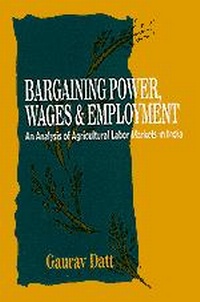
Bargaining Power, Wages and Employment
An Analysis of Agricultural Labor Markets in India
1st Edition
Published on 25. November 1996
Book
Hardback
224 pages
978-0-8039-9338-9 (ISBN)
Description
This study of agricultural labour markets in India focuses on one of the most deprived groups in the country - agricultural labourers. Using data from five different agro-climatic zones, the author develops a new bargaining model for the casual labour market at the village level. Topics of particular interest include: the analysis of quasi-cooperative forms of behaviour that persist even where labour unions are nonexistent; and the importance of recognizing gender disparity in bargaining power.
Reviews / Votes
`The book makes fascinating reading and appears to tackle much of the complexity in the process of determiniation of the agricultural wage rate' - Indian Journal of Agricultural EconomicsMore details
Edition
First Edition
Language
English
Place of publication
Thousand Oaks
United States
Target group
Professional and scholarly
Weight
389 gr
ISBN-13
978-0-8039-9338-9 (9780803993389)
Copyright in bibliographic data and cover images is held by Nielsen Book Services Limited or by the publishers or by their respective licensors: all rights reserved.
Schweitzer Classification
Content
Introduction
Agricultural Wage and Employment Determination in India
A Review of Theory and Evidence
Village-Level Markets for Agricultural Labour and Tacit Collective Bargaining
A Bargain-Theoretic Analysis of Agricultural Labour Markets
Estimation of the Basic Wage Bargaining Model
Estimation of the Extended Wage Bargaining Model
Seasonality, Regional Variations and the Distributional Effects of Unequal Bargaining Power
Conclusion
Agricultural Wage and Employment Determination in India
A Review of Theory and Evidence
Village-Level Markets for Agricultural Labour and Tacit Collective Bargaining
A Bargain-Theoretic Analysis of Agricultural Labour Markets
Estimation of the Basic Wage Bargaining Model
Estimation of the Extended Wage Bargaining Model
Seasonality, Regional Variations and the Distributional Effects of Unequal Bargaining Power
Conclusion