

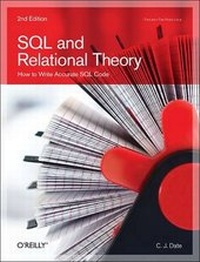
SQL and Relational Theory
How to Write Accurate SQL Code
2nd Edition
Published on 24. January 2012
Book
444 pages
978-1-4493-1640-2 (ISBN)
Description
SQL is full of difficulties and traps for the unwary. You can avoid them if you understand relational theory, but only if you know how to put the theory into practice. In this insightful book, author C.J. Date explains relational theory in depth, and demonstrates through numerous examples and exercises how you can apply it directly to your use of SQL.
This second edition includes new material on recursive queries, "missing information" without nulls, new update operators, and topics such as aggregate operators, grouping and ungrouping, and view updating. If you have a modest-to-advanced background in SQL, you'll learn how to deal with a host of common SQL dilemmas.
* Why is proper column naming so important?
* Nulls in your database are causing you to get wrong answers. Why? What can you do about it?
* Is it possible to write an SQL query to find employees who have never been in the same department for more than six months at a time?
* SQL supports "quantified comparisons," but they're better avoided. Why? How do you avoid them?
* Constraints are crucially important, but most SQL products don't support them properly. What can you do to resolve this situation?
Database theory and practice have evolved since the relational model was developed more than 40 years ago. SQL and Relational Theory draws on decades of research to present the most up-to-date treatment of SQL available.
C.J. Date has a stature that is unique within the database industry. A prolific writer well known for the bestselling textbook An Introduction to Database Systems (Addison-Wesley), he has an exceptionally clear style when writing about complex principles and theory.
This second edition includes new material on recursive queries, "missing information" without nulls, new update operators, and topics such as aggregate operators, grouping and ungrouping, and view updating. If you have a modest-to-advanced background in SQL, you'll learn how to deal with a host of common SQL dilemmas.
* Why is proper column naming so important?
* Nulls in your database are causing you to get wrong answers. Why? What can you do about it?
* Is it possible to write an SQL query to find employees who have never been in the same department for more than six months at a time?
* SQL supports "quantified comparisons," but they're better avoided. Why? How do you avoid them?
* Constraints are crucially important, but most SQL products don't support them properly. What can you do to resolve this situation?
Database theory and practice have evolved since the relational model was developed more than 40 years ago. SQL and Relational Theory draws on decades of research to present the most up-to-date treatment of SQL available.
C.J. Date has a stature that is unique within the database industry. A prolific writer well known for the bestselling textbook An Introduction to Database Systems (Addison-Wesley), he has an exceptionally clear style when writing about complex principles and theory.
More details
Other editions
New editions
Book
12/2015
3rd Edition
O'Reilly
€37.50
Article not available at the moment
Previous edition
Book
03/2009
1st Edition
O'Reilly
€38.00
Article exhausted; check for reprint
Person
C.J. Date has a stature that is unique within the database industry. C.J. is a prolific writer, and is well-known for his best-selling textbook: An Introduction to Database Systems (Addison Wesley). C.J. is an exceptionally clear-thinking writer who can lay out principles and theory in a way easily understood by his audience.