

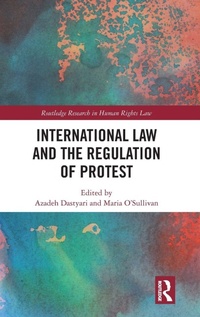
International Law and the Regulation of Protest
1st Edition
Will be published approx. on 3. February 2026
Book
Hardback
234 pages
978-1-032-86357-3 (ISBN)
Description
This book provides a systematic analysis of the international legal regime governing protest from a human rights law perspective. Through it, readers gain an introduction to the idea of protest, and how it is understood and regulated.
The first section of this book provides a conceptual and doctrinal introduction to protests. It examines the human right to the freedom of assembly, and how it inter-relates with expressive freedoms. Comparative examples are provided from both liberal and non-liberal states. The second half of the book offers case studies on specific types of protest. These include climate protests, Indigenous protests, gender-related protests, citizenship protests and digital protest. The book seeks to draw out internationally recognised standards when it comes to engaging in and policing protest activities. A concluding chapter also looks towards the future governance of protest and protest movements.
With timely relevance to contemporary protest movements like Black Lives Matter and environmental justice, this book will appeal to academics and students of human rights law, constitutional law, and international law. It will also appeal to scholars of social justice, social change, and peace / conflict studies.
The first section of this book provides a conceptual and doctrinal introduction to protests. It examines the human right to the freedom of assembly, and how it inter-relates with expressive freedoms. Comparative examples are provided from both liberal and non-liberal states. The second half of the book offers case studies on specific types of protest. These include climate protests, Indigenous protests, gender-related protests, citizenship protests and digital protest. The book seeks to draw out internationally recognised standards when it comes to engaging in and policing protest activities. A concluding chapter also looks towards the future governance of protest and protest movements.
With timely relevance to contemporary protest movements like Black Lives Matter and environmental justice, this book will appeal to academics and students of human rights law, constitutional law, and international law. It will also appeal to scholars of social justice, social change, and peace / conflict studies.
More details
Series
Language
English
Place of publication
London
United Kingdom
Publishing group
Taylor & Francis Ltd
Target group
College/higher education
Postgraduate
Dimensions
Height: 240 mm
Width: 161 mm
Thickness: 18 mm
Weight
540 gr
ISBN-13
978-1-032-86357-3 (9781032863573)
Copyright in bibliographic data and cover images is held by Nielsen Book Services Limited or by the publishers or by their respective licensors: all rights reserved.
Schweitzer Classification
Other editions
Additional editions
Azadeh Dastyari | Maria O'Sullivan
International Law and the Regulation of Protest
E-Book
02/2026
1st Edition
Routledge
€60.99
Available for download
Azadeh Dastyari | Maria O'Sullivan
International Law and the Regulation of Protest
E-Book
02/2026
1st Edition
Routledge
€60.99
Available for download
Persons
Azadeh Dastyari is a Professor of Human Rights Law and the Director of the Centre for Western Sydney, Australia, where she oversees a wide range of high-impact, equity-focused initiatives. Before joining the Centre, Azadeh was the Director of Research and Policy at the Whitlam Institute.
Maria O'Sullivan is an Associate Professor at the Deakin Law School in Melbourne, Australia, specialising in refugee law and human rights law. Her work has been cited by the High Court of Australia, the Court of Justice of the European Union and in a number of government inquiries.
Maria O'Sullivan is an Associate Professor at the Deakin Law School in Melbourne, Australia, specialising in refugee law and human rights law. Her work has been cited by the High Court of Australia, the Court of Justice of the European Union and in a number of government inquiries.
Content
1. Introduction: Defining and Contextualising the Right to Protest under International Human Rights Law Part 1: Conceptual Background to the Right to Protest 2. The Right to Protest under International Human Rights Law 3. Realising an Effective Right to Protest: Impediments and Opportunities Part 2: Case Studies 4. Petitioners, Protestors or Protectors? A Short History of Indigenous People and Protest 5. The Securitisation of Environmental and Climate Protest: Property Damage and Ecotage as Disarmament 6. Gender and Protest: What do 'Nasty Women' Want? Human Rights, Then and Now! 7. The Regulation of Protests by Non-Citizens: Migrants, Refugeehood and Citizenship 8. Social Media in the Life Cycle of Protest: Case Studies from Latin America Part 3: Conclusions 9. Conclusion: Defending Protest as a Human Right in a Changing World