

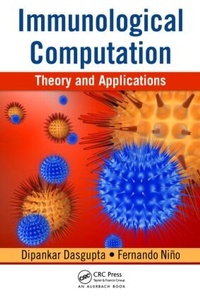
Immunological Computation
Theory and Applications
1st Edition
Published on 12. September 2008
Book
Hardback
296 pages
978-1-4200-6545-9 (ISBN)
Description
Clearly, nature has been very effective in creating organisms that are capable of protecting themselves against a wide variety of pathogens such as bacteria, fungi, and parasites. The powerful information-processing capabilities of the immune system, such as feature extraction, pattern recognition, learning, memory, and its distributive nature provide rich metaphors that researchers are finding very useful for the development of computational models. While some of these models are designed to give us a better understanding of the immune system, other models are being developed to solve complex real-world problems such as anomaly detection, pattern recognition, data analysis (clustering), function optimization, and computer security.
Immunological Computation: Theory and Applications is devoted to discussing different immunological mechanisms and their relation to information processing and problem solving. This unique volume presents a compendium of up-to-date work related to immunity-based techniques. After presenting the general abstractions of immune elements and processes used in computational models, it then-
Reviews standard procedures, representations, and matching rules that are used in all immunological computation models
Covers the details of one of the earliest and most well-known immune algorithms, based on the negative selection (NS) process that occurs in the thymus
Examines promising immune models, including those based on danger theory, cytokine network models, and MHC-based models
The text goes further to describe a wide variety of applications, which include computer security, the detection and analysis of anomalies and faults, robotics, and data mining among others. To enhance understanding of this emerging field of study, each chapter includes a summary, review questions, and exercis
Immunological Computation: Theory and Applications is devoted to discussing different immunological mechanisms and their relation to information processing and problem solving. This unique volume presents a compendium of up-to-date work related to immunity-based techniques. After presenting the general abstractions of immune elements and processes used in computational models, it then-
Reviews standard procedures, representations, and matching rules that are used in all immunological computation models
Covers the details of one of the earliest and most well-known immune algorithms, based on the negative selection (NS) process that occurs in the thymus
Examines promising immune models, including those based on danger theory, cytokine network models, and MHC-based models
The text goes further to describe a wide variety of applications, which include computer security, the detection and analysis of anomalies and faults, robotics, and data mining among others. To enhance understanding of this emerging field of study, each chapter includes a summary, review questions, and exercis
More details
Language
English
Place of publication
London
United Kingdom
Publishing group
Taylor & Francis Ltd
Target group
Professional and scholarly
Academic and Professional Practice & Development
Dimensions
Height: 234 mm
Width: 156 mm
Weight
544 gr
ISBN-13
978-1-4200-6545-9 (9781420065459)
Copyright in bibliographic data and cover images is held by Nielsen Book Services Limited or by the publishers or by their respective licensors: all rights reserved.
Schweitzer Classification
Other editions
Additional editions
Book
09/2019
1st Edition
CRC Press
€89.00
Shipment within 15-20 days
E-Book
09/2008
Auerbach
€81.99
Available for download
E-Book
09/2008
Auerbach
€81.99
Available for download
Persons
Dasgupta, Dipankar; Nino, Fernando
Content
Immunology Basics. Modeling the Biological Immune System. Negative Selection. Artificial Immune Networks. Clonal Selection Algorithm and Hybrid Models. Applications.