

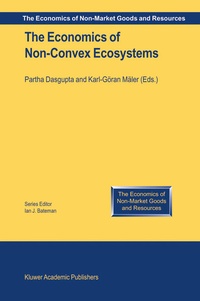
The Economics of Non-Convex Ecosystems
Published on 31. January 2004
Book
Paperback/Softback
VI, 190 pages
978-1-4020-1864-0 (ISBN)
Description
Economists all too often assume that ecosystem and population dynamics are subject to convex (even linear) processes. However, research by ecosystem and population ecologists has shown that the processes in question are very often non-convex. This has important implications for environmental and resource economics. Typically, a system under study or being managed would contain multiple basins of attraction. So the system would flip from one basin to another if a "threshold" (mathematically, a bifurcation) were crossed. Furthermore, the flip could be irreversible. But even if it were reversible, the system could well display hysteresis. The latter eventuality means that in order to entice the system to return to its original basin of attraction, a different and possibly costly path has to be traced. A mistake in management may then be a lot more costly than envisaged. An example would be a possible flip of the Gulf Stream owing to fresh water intrusion from melting glaciers during global warming.
More details
Series
Edition
2004 ed.
Language
English
Place of publication
Dordrecht
Netherlands
Target group
Professional and scholarly
Research
Product notice
Paperback (trade)
Unsewn / adhesive bound
Illustrations
VI, 190 p.
Dimensions
Height: 234 mm
Width: 156 mm
Thickness: 11 mm
Weight
281 gr
ISBN-13
978-1-4020-1864-0 (9781402018640)
DOI
10.1007/1-4020-2515-7
Schweitzer Classification
Other editions
Additional editions
Partha Dasgupta | Karl-Göran Mäler
The Economics of Non-Convex Ecosystems
E-Book
04/2006
Springer
€96.29
Available for download
Partha Dasgupta | Karl-Göran Mäler
The Economics of Non-Convex Ecosystems
Book
01/2004
Springer
€106.99
Shipment within 15-20 days
Content
The Economics of Non-Convex Ecosystems: Introduction.- Scale and Scaling in Ecological and Economic Systems.- Convex Relationships in Ecosystems Containing Mixtures of Trees and Grass.- Managing Systems with Non-convex Positive Feedback.- The Economics of Shallow Lakes.- Multiple Species Boreal Forests - What Faustmann Missed.- Evaluating Projects and Assessing Sustainable Development in Imperfect Economies.