

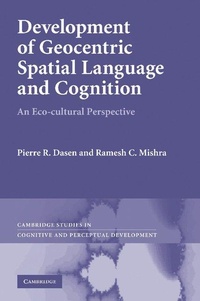
Development of Geocentric Spatial Language and Cognition
An Eco-cultural Perspective
Published on 3. January 2013
Book
Paperback/Softback
410 pages
978-1-107-41248-4 (ISBN)
Description
Egocentric spatial language uses coordinates in relation to our body to talk about small-scale space ('put the knife on the right of the plate and the fork on the left'), while geocentric spatial language uses geographic coordinates ('put the knife to the east, and the fork to the west'). How do children learn to use geocentric language? And why do geocentric spatial references sound strange in English when they are standard practice in other languages? This book studies child development in Bali, India, Nepal, and Switzerland and explores how children learn to use a geocentric frame both when speaking and performing non-verbal cognitive tasks (such as remembering locations and directions). The authors examine how these skills develop with age, look at the socio-cultural contexts in which the learning takes place, and explore the ecological, cultural, social, and linguistic conditions that favor the use of a geocentric frame of reference.
Reviews / Votes
'A remarkable illustration of how research can integrate concepts, methods and findings from cognitive and developmental psychology, as well as from cultural anthropology and linguistics, to explain the development and use of spatial frames of reference in a number of cultures.' John W. Berry, Queen's University, Canada 'A wonderful contribution to the literature on child development in relation to language and culture.' Penelope Brown, Max Planck Institute for Psycholinguistics 'Dasen and Mishra invite us to revisit the concept of spatial knowledge from a radically decentered perspective. From Bali through India to Nepal, they treat us to a fascinating journey into a variety of cultures. This book offers a richly documented, refreshing alternative to the Western view of human spatial cognition and language.' Michel Denis, LIMSI-CNRS, National Center for Scientific Research, OrsayMore details
Series
Language
English
Place of publication
Cambridge
United Kingdom
Target group
Professional and scholarly
Product notice
Paperback (trade)
Dimensions
Height: 229 mm
Width: 152 mm
Thickness: 22 mm
Weight
591 gr
ISBN-13
978-1-107-41248-4 (9781107412484)
Copyright in bibliographic data and cover images is held by Nielsen Book Services Limited or by the publishers or by their respective licensors: all rights reserved.
Schweitzer Classification
Other editions
Additional editions
Pierre R. Dasen | Ramesh C. Mishra
Development of Geocentric Spatial Language and Cognition
An Eco-cultural Perspective
E-Book
09/2010
1st Edition
Cambridge University Press
€26.49
Available for download
Pierre R. Dasen | Ramesh C. Mishra
Development of Geocentric Spatial Language and Cognition
An Eco-cultural Perspective
Book
08/2010
Cambridge University Press
€151.10
Shipment within 15-20 days
Persons
Content
Part I. Introduction and Methods: 1. Theory and research questions; 2. Methods; 3. Settings; Part II. Results: 4. Pilot study in Bali and first study (India and Nepal, 1999-2000); 5. Returning to Bali: main study 2002-7; 6. Varanasi; 7. Kathmandu; 8. Panditpur; 9. Geneva; Part III. Additional Studies: 10. Spatial language addressed to children; 11. Geocentric gestures before language?; 12. Spatial organization schemes; 13. Neurophysiological correlates of geocentric space; 14. Geocentric dead reckoning; Part IV. Conclusions: 15. Discussion and conclusions; Appendix 1. Summary of instructions, questionnaires, and coding schemes; Appendix 2. Examples of language in each location; Appendix 3. Extracts from school manuals.