

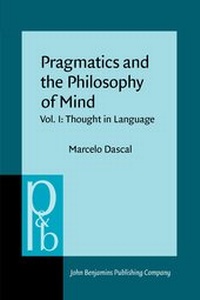
Pragmatics and the Philosophy of Mind
Vol. I: Thought in Language
Published on 1. January 1983
Book
Paperback/Softback
207 pages
978-90-272-2503-0 (ISBN)
Description
This volume deals with the relation between pragmatics and the philosophy of mind. Unlike most of the books written on the subject, it does not defend the view that a specific form of dependence holds between language and thought, to the exclusion of all other possible relations. Taking pragmatics in its original sense of "that part of semiotics that is concerned with the users of a semiotic system", the book analyses the nature of the mental processes and states mirrored in language use. Drawing on results from cognitive psychology, the philosophy of mind, the philosophy of language, linguistics, etc., a unified view of the mental dimension in the use of language, both as an instrument of communication and as an instrument of thought, is offered. After offering a tour d'horizon of the relationship between language and mind, this volume deals with the way thought is manifested in language.
More details
Series
Language
English
Place of publication
Amsterdam
Netherlands
Target group
College/higher education
Professional and scholarly
Dimensions
Height: 240 mm
Width: 160 mm
Weight
320 gr
ISBN-13
978-90-272-2503-0 (9789027225030)
Copyright in bibliographic data and cover images is held by Nielsen Book Services Limited or by the publishers or by their respective licensors: all rights reserved.
Schweitzer Classification
Other editions
Additional editions
E-Book
01/1983
1st Edition
John Benjamins Publishing Company
€93.49
Available for download
Content
1. Preface; 2. 1. Introduction: Language - Mirror of the Mind; 3. 1.1. Variations on a theme; 4. 1.2. Functionalism; 5. 1.3. Pragmatics; 6. 1.4. Sociopragmatics, psychopragmatics, and the philosophy of mind; 7. 1.5. Language-in-use: Mirror of the mind; 8. Part I Thought in Language; 9. 2. Transparency; 10. 2.1. The assumption of transparency; 11. 2.2. Speaking and listening; 12. 2.3. Naturalness; 13. 2.4. Pragmatic interpretation; 14. 2.5. Expressibility and context; 15. 2.6. The ascription of content; 16. 2.7. The transparency of discourse; 17. 2.8. Principles of transparency; 18. 3. Indirectness; 19. 3.1. Meaning something else; 20. 3.2. Toward a heuristics of indirect interpretation; 21. 3.3. Alternative meanings and alternative expressions; 22. 3.4. Why do we use indirectness?; 23. Notes; 24. References; 25. Index