

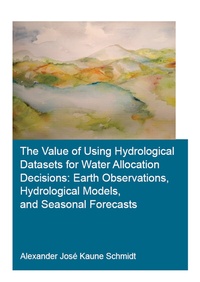
The Value of Using Hydrological Datasets for Water Allocation Decisions: Earth Observations, Hydrological Models and Seasonal Forecasts
1st Edition
Published on 12. November 2019
Book
Paperback/Softback
168 pages
978-0-367-42955-3 (ISBN)
Description
An increasing number of hydrological datasets from earth observations, hydrological models and seasonal forecasts have become available for water managers, consultants and the general public. These datasets are state-of-the-art products which are usually accessible online and may contribute to develop hydrological studies and support water resources management. However, the added value of these datasets has not been completely explored in decision-making processes. Research studies have assessed how well data can help in predicting climate, but there is a lack of knowledge on how well data can help in water allocation decisions. This work provides numerical tools, methods and results to evaluate the value of using hydrological datasets to support water allocation decisions at river basin and irrigation district scale. An integrated approach is used to predict climate, improve decisions and reduce negative impacts. Results show that investing in hydrological data with finer spatial and temporal resolution and longer periods of record improves water allocation decisions and reduces agricultural production loss in large irrigation schemes. Using river discharge data from hydrological models and global precipitation enhances irrigation area planning when little in-situ data is available. Moreover, using seasonal streamflow forecasts improves available water estimates resulting in better water allocation decisions. The framework was tested in Costa Rica, Colombia and Australia, but can be applied in any case study around the world.
More details
Series
Language
English
Place of publication
London
United Kingdom
Publishing group
Taylor & Francis Ltd
Target group
Professional and scholarly
Dimensions
Height: 240 mm
Width: 170 mm
Weight
340 gr
ISBN-13
978-0-367-42955-3 (9780367429553)
Copyright in bibliographic data and cover images is held by Nielsen Book Services Limited or by the publishers or by their respective licensors: all rights reserved.
Schweitzer Classification
Other editions
Additional editions
Anirban Das | Gyandshwar Kumar Rao | Kasinath Ojha
The Value of Using Hydrological Datasets for Water Allocation Decisions: Earth Observations, Hydrological Models and Seasonal Forecasts
E-Book
11/2019
1st Edition
CRC Press
€107.99
Available for download
Anirban Das | Gyandshwar Kumar Rao | Kasinath Ojha
The Value of Using Hydrological Datasets for Water Allocation Decisions: Earth Observations, Hydrological Models and Seasonal Forecasts
E-Book
11/2019
1st Edition
CRC Press
€107.99
Available for download
Persons
Alexander Jose Kaune Schmidt was born in Germany, raised in Costa Rica and currently working as a consultant in a Dutch company with special interest in developing projects in Costa Rica. He is an Agricultural Engineer with an MSc degree in Hydraulic Engineering, and over ten years of work experience in water and agriculture projects in the commercial, government, and research sector in the Netherlands, Costa Rica, Colombia, Angola, Georgia, Iran and Australia. Alexander also has experience in consultancy and research projects for hydrological assessment, biomass growth evaluation, and irrigation advice using ground data, numerical tools and remote sensing. He is skilled in project management, valuation methods, simulation models and risk assessment, and passionate about solving problems related to climate change, water supply, food and fibre production and irrigation system operation and planning.
Content
General introduction, A tool to assess available hydrological information and water allocation decisions, The benefit of using an ensemble of global hydrological models in surface water availability estimates, Can global precipitation datasets benefit the estimation of the area to be cropped?, The benefit of using an ensemble of seasonal streamflow forecasts, Synthesis and recommendations for future research.