

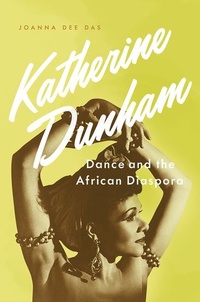
Katherine Dunham
Dance and the African Diaspora
Published on 20. July 2017
Book
Hardback
288 pages
978-0-19-026487-1 (ISBN)
Description
One of the most important dance artists of the twentieth century, dancer and choreographer Katherine Dunham (1909-2006) created works that thrilled audiences the world over. As an African American woman, she broke barriers of race and gender, most notably as the founder of an important dance company that toured the United States, Latin America, Europe, Asia, and Australia for several decades. Through both her company and her schools, she influenced generations of performers for years to come, from Alvin Ailey to Marlon Brando to Eartha Kitt. Dunham was also one of the first choreographers to conduct anthropological research about dance and translate her findings for the theatrical stage.
Katherine Dunham: Dance and the African Diaspora makes the argument that Dunham was more than a dancer-she was an intellectual and activist committed to using dance to fight for racial justice. Dunham saw dance as a tool of liberation, as a way for people of African descent to reclaim their history and forge a new future. She put her theories into motion not only through performance, but also through education, scholarship, travel, and choices about her own life.
Author Joanna Dee Das examines how Dunham struggled to balance artistic dreams, personal desires, economic needs, and political commitments in the face of racism and sexism. The book analyzes Dunham's multiple spheres of engagement, assessing her dance performances as a form of black feminist protest while also presenting new material about her schools in New York and East St. Louis, her work in Haiti, and her network of interlocutors that included figures as diverse as ballet choreographer George Balanchine and Senegalese president Leopold Sedar Senghor. It traces Dunham's influence over the course of several decades from the New Negro Movement of the 1920s to the Black Power Movement of the late 1960s and beyond.
By drawing on a vast, never-utilized trove of archival materials along with oral histories, choreographic analysis, and embodied research, Katherine Dunham: Dance and the African Diaspora offers new insight about how this remarkable woman built political solidarity through the arts.
Katherine Dunham: Dance and the African Diaspora makes the argument that Dunham was more than a dancer-she was an intellectual and activist committed to using dance to fight for racial justice. Dunham saw dance as a tool of liberation, as a way for people of African descent to reclaim their history and forge a new future. She put her theories into motion not only through performance, but also through education, scholarship, travel, and choices about her own life.
Author Joanna Dee Das examines how Dunham struggled to balance artistic dreams, personal desires, economic needs, and political commitments in the face of racism and sexism. The book analyzes Dunham's multiple spheres of engagement, assessing her dance performances as a form of black feminist protest while also presenting new material about her schools in New York and East St. Louis, her work in Haiti, and her network of interlocutors that included figures as diverse as ballet choreographer George Balanchine and Senegalese president Leopold Sedar Senghor. It traces Dunham's influence over the course of several decades from the New Negro Movement of the 1920s to the Black Power Movement of the late 1960s and beyond.
By drawing on a vast, never-utilized trove of archival materials along with oral histories, choreographic analysis, and embodied research, Katherine Dunham: Dance and the African Diaspora offers new insight about how this remarkable woman built political solidarity through the arts.
Reviews / Votes
Das offers a balanced and loving account of a complex person living and dancing across complex times (nearly a century, 1909-2006). She presents Dunham's history as a deft and daring navigation of a uniquely American tangle of racial, gender, and class norms. * Sima Belmar, Dancers Group * Dee Das (Washington Univ., St. Louis) offers a smoothly written account of the challenges surrounding celebrity artist and activist Katherine Dunham (1909-2006). The author establishes 'politics of diaspora' as an analytic mode to connect Dunham's research and political aspirations in the Caribbean--especially Haiti--to her work in Senegal and the US. Dee Das explores ways that race constrained and enlivened Dunham's creative process, and she includes lively descriptions of seminal ballets, including early works that were proposed but never performed ... lively descriptions of seminal ballets, including early works that were proposed but never performed ... Recommended. Lower-division undergraduates through faculty and professionals; general readers. * Choice * Katherine Dunham is an important addition to the field of dance studies, critical race studies, and transnational American studies, as the book, like its subject, defies easy categorization. At once a cogent biography and an exemplary case study in the messiness and, oten, the riskiness of diasporic politics and performance. Katherine Dunham will no doubt prove instructive to scholars and students across dsciplines. * Doria E. Charlson, DRJ * Joanna Dee Das brilliantly congeals historiography and dance studies, giving us a probing inquiry of new diasporan perspectives on Katherine Dunham as one of the most complex world dance figures of the 20th century. Das meticulous archival research reveals longed-for details about Dunhams awareness of her Africanist aesthetic in dance and her constant fight against racism what Das astutely calls her politics of diaspora. * Halifu Osumare, Professor Emerita, University of California, Davis and former co-director, Institute for Dunham Technique Certification * The first scholar to fully plumb the archive, Joanna Dee Das offers an incisive portrait of Dunham as artist and activist whose multifaceted career profoundly shaped understandings of the African diaspora in her time and in ours. * Susan Manning, Professor of English, Theatre, and Performance Studies, Northwestern University *More details
Language
English
Place of publication
New York
United States
Target group
College/higher education
Professional and scholarly
Illustrations
26 illustrations
Dimensions
Height: 239 mm
Width: 157 mm
Thickness: 30 mm
Weight
540 gr
ISBN-13
978-0-19-026487-1 (9780190264871)
Copyright in bibliographic data and cover images is held by Nielsen Book Services Limited or by the publishers or by their respective licensors: all rights reserved.
Schweitzer Classification
Other editions
Additional editions

E-Book
05/2017
1st Edition
OUP eBook
€18.99
Available for download

E-Book
05/2017
1st Edition
OUP eBook
€18.99
Available for download
Person
Joanna Dee Das is an assistant professor of dance at Washington University in St. Louis. She received her PhD in history and is a Certified Dunham Technique instructor. Her writing has appeared in Dance Research Journal, Journal of American History, Journal of African American History, Journal of Urban History, and Studies in Musical Theatre.
Content
List of Illustrations
Preface and Acknowledgments
Introduction
Chapter 1: Becoming a New Negro
Chapter 2: Finding a Politics of Diaspora in the Caribbean
Chapter 3: Aesthetics as Politics
Chapter 4: Race and Representation During World War II
Chapter 5: Rehearsal for Revolution at the Dunham School
Chapter 6: The Unofficial Ambassador of Diaspora
Chapter 7: Living Diaspora in Haiti and Senegal
Chapter 8: The Radical Humanist Meets the Black Power Revolution in East St. Louis
Epilogue: Dunham's Legacy
List of Abbreviations
Notes
Bibliography
Index
Preface and Acknowledgments
Introduction
Chapter 1: Becoming a New Negro
Chapter 2: Finding a Politics of Diaspora in the Caribbean
Chapter 3: Aesthetics as Politics
Chapter 4: Race and Representation During World War II
Chapter 5: Rehearsal for Revolution at the Dunham School
Chapter 6: The Unofficial Ambassador of Diaspora
Chapter 7: Living Diaspora in Haiti and Senegal
Chapter 8: The Radical Humanist Meets the Black Power Revolution in East St. Louis
Epilogue: Dunham's Legacy
List of Abbreviations
Notes
Bibliography
Index