

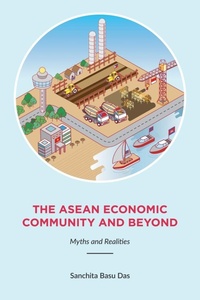
The Asean Economic Community and Beyond
Myths and Realities
Published on 30. December 2015
Book
Paperback/Softback
308 pages
978-981-4695-17-6 (ISBN)
Description
The year 2015 has special significance for regional economic integration. The ASEAN Community, integrating the political, economic and social aspects of regional cooperation, will complete its first milestone by December 2015. Expectations of tangible benefits under an ASEAN Economic Community have attracted much attention though many of the initiatives will be realized post-2015.
Following the policy of open regionalism, ASEAN has also signed free trade agreements with Australia, New Zealand, China, India, Japan and South Korea. It has launched negotiations for the Regional Comprehensive Economic Partnership (RCEP) agreement in 2013, with expected breakthrough by end-2015.
The Southeast Asian economies are also involved in two other regional initiatives. First is the Trans-Pacific Partnership (TPP), initiated by the United States. As part of the U.S. ""pivot to Asia"", the TPP is envisioned as a ""comprehensive and high-quality"" agreement and has concluded its negotiation in October 2015. Second, the discussions on regional connectivity have broadened; China has emerged as a recent lead proponent with its proposals for ""One Belt, One Road"" and the Asian Infrastructure Investment Bank.
All these together have implications not only for individual Southeast Asian countries but also for regional trading architecture. To aid in understanding the beginnings, development, and potential of these grand plans, this collection of 22 essays offers a rich analysis of ASEAN's own economic integration and other related initiatives proliferating in the broader Asia-Pacific region
Following the policy of open regionalism, ASEAN has also signed free trade agreements with Australia, New Zealand, China, India, Japan and South Korea. It has launched negotiations for the Regional Comprehensive Economic Partnership (RCEP) agreement in 2013, with expected breakthrough by end-2015.
The Southeast Asian economies are also involved in two other regional initiatives. First is the Trans-Pacific Partnership (TPP), initiated by the United States. As part of the U.S. ""pivot to Asia"", the TPP is envisioned as a ""comprehensive and high-quality"" agreement and has concluded its negotiation in October 2015. Second, the discussions on regional connectivity have broadened; China has emerged as a recent lead proponent with its proposals for ""One Belt, One Road"" and the Asian Infrastructure Investment Bank.
All these together have implications not only for individual Southeast Asian countries but also for regional trading architecture. To aid in understanding the beginnings, development, and potential of these grand plans, this collection of 22 essays offers a rich analysis of ASEAN's own economic integration and other related initiatives proliferating in the broader Asia-Pacific region
More details
Language
English
Place of publication
Pasir Panjang
Singapore
Target group
Professional and scholarly
Dimensions
Height: 229 mm
Width: 152 mm
Thickness: 17 mm
Weight
449 gr
ISBN-13
978-981-4695-17-6 (9789814695176)
Copyright in bibliographic data and cover images is held by Nielsen Book Services Limited or by the publishers or by their respective licensors: all rights reserved.
Schweitzer Classification
Other editions
Additional editions
E-Book
06/2018
Iseas Publishing
€28.95
Available for download
Person
Sanchita Basu Das is an ISEAS Fellow and Lead Researcher (Economic Affairs) at the ASEAN Studies Centre, Institute of Southeast Asian Studies (ISEAS), Singapore.