

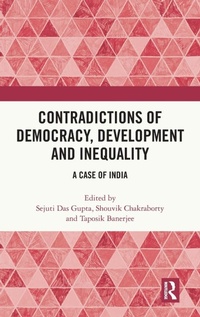
Contradictions of Democracy, Development and Inequality
A Case of India
1st Edition
Published on 23. July 2025
Book
Hardback
264 pages
978-1-032-29188-8 (ISBN)
Description
Identity politics has widened representation for the marginalised groups in democracies, while neoliberalism has deepened inequality. This volume finds answers to the paradox of widening representation and worsening inequality especially in India exploring the themes of development and identity in recent times.
Inspired by Caesar Basu's works as a political thinker, this volume weaves in economic concerns with the socio-cultural aspects of identity and contends that representation is not sufficient. Further, it highlights the importance of reinstating redistribution to serve both democracy and development. It looks at neoliberal policies and how they maximise negative liberty by focussing on the individual thereby obliterating the question of the social location of individuals. The contributors to this volume investigate these issues through the lens of religion, gender, caste, and raise interdisciplinary questions concerning ecological conditions of labour, the institution of democracy and capitalist regimes, linkages among multiple sectors of the Indian economy, devaluation of women's work in the care economy, material distribution of resources, and liberty and civil rights. This book creates a much-needed conversation between the study of development through the economic perspective and the cultural or political sociology perspective.
It will be of interest to students and researchers of politics especially identity politics, economics, sociology and social justice, development studies, and social geography.
Inspired by Caesar Basu's works as a political thinker, this volume weaves in economic concerns with the socio-cultural aspects of identity and contends that representation is not sufficient. Further, it highlights the importance of reinstating redistribution to serve both democracy and development. It looks at neoliberal policies and how they maximise negative liberty by focussing on the individual thereby obliterating the question of the social location of individuals. The contributors to this volume investigate these issues through the lens of religion, gender, caste, and raise interdisciplinary questions concerning ecological conditions of labour, the institution of democracy and capitalist regimes, linkages among multiple sectors of the Indian economy, devaluation of women's work in the care economy, material distribution of resources, and liberty and civil rights. This book creates a much-needed conversation between the study of development through the economic perspective and the cultural or political sociology perspective.
It will be of interest to students and researchers of politics especially identity politics, economics, sociology and social justice, development studies, and social geography.
Reviews / Votes
'This fascinating volume addresses a central concern of our times: the complex relationship between economic processes, inequality, social identities, democracy and political outcomes. The wealth of informative, thought-provoking and insightful analyses from different perspectives by some of the most important social scientists in India makes this a must-read for anyone interested in these issues in India and anywhere in the world.'-Jayati Ghosh, Professor of Economics, University of Massachusetts Amherst, USA.
'This volume comprises of a very rich collection of essays by scholars from varied disciplines examining the critical relationships between democracy, development and inequality in the Indian context. Each of these contributions engage with recent debates on the issue, and have conducted empirically based research. What is striking about this volume is that it has addressed the inter-connection between democracy and development with a special focus on minorities such as Muslims, women and dalits. This makes it a very unique volume and will help reader to make sense of the dark side of Indian democracy with greater clarity.'
-Dr Mujibur Rehman, author of Shikwa-e- Hind: The Political Future of Indian Muslims (2024), Jamia Millia Central University, New Delhi, India
'This book is a fascinating collection of essays that interrogate one of the most enduring contradictions of the expansion of democratic recognition and rights: the inability to ensure democratic outcomes, in economic opportunities, incomes and sustenance, for the less privileged sections of society in India. The wide expanse of issues covered in looking at the relationship between the expansion of political recognition of marginalised social groups and the exacerbation of inter-group inequality on caste, class and gender lines, and the severe erosion of access to the fruits of development in the globalised phase in India makes this a very rich volume.'
-Prof. Sumangala Damodaran, Director, Gender and Economics, IDEAs
'The authors and editors of this volume have provided an apt tribute to the intellectual thought and legacy of the late Caesar Basu. A scholar without a befitting degree, Caesar's commitment to values linked to democracy, social justice and development were reflected in his Socratic approach to learning and sharing knowledge with his peers, friends and even his teachers. By addressing the topics that were close to Caesar's heart and that piqued his intellectual curiosity, the authors have carried forward his mission that was cut short due to his death. At a time when large parts of the world, including India, have lurched to the Right, the need to sharpen the intellectualism of the Left-Liberal stream has never been more paramount and this collection of essays is a key addition in that direction.'
-Srinivasan Ramani, Deputy National Editor, The Hindu
More details
Language
English
Place of publication
London
United Kingdom
Publishing group
Taylor & Francis Ltd
Target group
College/higher education
Postgraduate
Illustrations
20 s/w Zeichnungen, 32 s/w Tabellen, 21 s/w Abbildungen, 1 s/w Photographie bzw. Rasterbild
32 Tables, black and white; 20 Line drawings, black and white; 1 Halftones, black and white; 21 Illustrations, black and white
Dimensions
Height: 240 mm
Width: 161 mm
Thickness: 20 mm
Weight
596 gr
ISBN-13
978-1-032-29188-8 (9781032291888)
Copyright in bibliographic data and cover images is held by Nielsen Book Services Limited or by the publishers or by their respective licensors: all rights reserved.
Schweitzer Classification
Other editions
Additional editions
Sejuti Das Gupta | Shouvik Chakraborty | Taposik Banerjee
Contradictions of Democracy, Development and Inequality
A Case of India
E-Book
07/2025
CRC Press
€60.49
Available for download
Sejuti Das Gupta | Shouvik Chakraborty | Taposik Banerjee
Contradictions of Democracy, Development and Inequality
A Case of India
E-Book
07/2025
CRC Press
€60.49
Available for download
Persons
Sejuti Das Gupta is an Associate professor at the Michigan State University, USA. She has also taught at the Tata Institute of Social Sciences, India. Her research is interdisciplinary and based on primary data and aims to contribute towards combining theory and practice for a better understanding in social science. Her most recent publication is called, Class, Politics and Agrarian Policies in Post-liberalisation India (2024).
Shouvik Chakraborty is an Assistant Research Professor at the Political Economy Research Institute (PERI) at the University of Massachusetts Amherst, USA. He specializes in environmental and energy economics, climate finance, job creation, and macroeconomics and is committed to addressing the urgent challenges posed by climate change. His recent research projects include analyzing the employment effects of President Biden's initiatives in green energy, manufacturing, and infrastructure in the United States.
Taposik Banerjee teaches Economics at the School of Liberal Studies, Dr. B. R. Ambedkar University Delhi, India. His research interests include social choice, law and economics and network theory. His recently published work is 'Characterization of a k-th best element rationalizable choice function with full domain', in the journal, Theory and Decision.
Shouvik Chakraborty is an Assistant Research Professor at the Political Economy Research Institute (PERI) at the University of Massachusetts Amherst, USA. He specializes in environmental and energy economics, climate finance, job creation, and macroeconomics and is committed to addressing the urgent challenges posed by climate change. His recent research projects include analyzing the employment effects of President Biden's initiatives in green energy, manufacturing, and infrastructure in the United States.
Taposik Banerjee teaches Economics at the School of Liberal Studies, Dr. B. R. Ambedkar University Delhi, India. His research interests include social choice, law and economics and network theory. His recently published work is 'Characterization of a k-th best element rationalizable choice function with full domain', in the journal, Theory and Decision.
Content
PART I Democracy 1. Recognition or Redistribution? Marxism and the National Question 2. Democracy, Subaltern Social Class and the Rise of Neoliberal Era 3. Is 'Recognition' an End in Itself? The Case of New State Formation in Chhattisgarh and Jharkhand PART II Development and Inequality 4. The Political Economy of Social Reproduction and Capital Accumulation in Post-independent India 5. Neoliberalism and Women's Work: A Study of the Informal Economy in India 6. Does Inequality Augment Employment Growth? Revisiting Marx, Kalecki and Kaldor in the Indian Context 7. The Informal Sector in India: Neo-dualism and Dual Policy Response PART III Natural Resource and Development 8. For Food and Livelihood: Rethinking the Role of Agriculture in India's Capitalist Development 9. Climate Change and Livestock Holding: Inequalities in Adaptation and the Need for Localised Policies 10. Right to Water, Privatisation and the Issue of Efficiency 11. Agriculture as a Source of Livelihood in Urban and Peri-Urban Areas: A Case of India after 2000 PART IV Identity Politics and Democracy 12. Muslims in New India: Some Preliminary Observations 13. Understanding the Postcolonial: Native versus Settlers and Brahmin versus Dalit 14. Mool-Niwasis or Khilonjias? Indigeneity, Hindutva and the Quest for Scheduled Tribe Status by Adivasis in Assam