

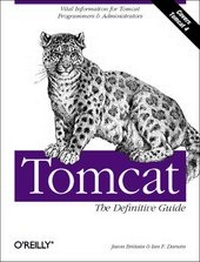
Tomcat: The Definitive Guide
The Definitive Guide
1st Edition
Published on 22. July 2003
Book
Paperback/Softback
322 pages
978-0-596-00318-0 (ISBN)
Description
Jakarta Tomcat is not only a commonly used open source servlet engine, it's become the de factor standard by which other servlet engines are measured. Powerful and flexible, it can be used as a standalone web server or in conjunction with another server, like Apache or IIS, to run servlets or JSPs. But mastery of Tomcat is not easy: because it's as complex as it is complete. This guide answers vexing questions that users, administrators, and developers alike have been asking. This concise guide provides much needed information to help harness Tomcat's power and wealth of features. "Tomcat: The Definitive Guide" offers something for everyone who uses Tomcat. System and network administrators will find detailed instructions on installation, configuration, and maintenance. For users, it supplies insightful information on how to deploy Tomcat. And seasoned enterprise Java developers will have a complete reference to setting up, running, and using this powerful software. The book begins with an introduction to the Tomcat server and includes an overview of the three types of server configurations: stand-alone, in-process, and out-of-process.
The authors show how directories are laid out, cover the initial setup, and describe how to set the environment variables and modify the configuration files, concluding with common errors, problems, and solutions. In subsequent chapters, they cover: the server.xml configuration file Java Security manager Authentication schemes and Tomcat users The Secure Socket Layer (SSL) Tomcat JDBC Realms Installing servletsand Java Server Pages Integrating Tomcat with Apache, IIS, and other servers Advanced Tomcat configuration and more. "Tomcat: The Definitive Guide" covers all major platforms, including Windows, Unix, Linux, and Mac OS X, contains details on Tomcat configuration files, and has a quick-start guide to get developers up and running with Java servlets and JavaServer Pages. If you've struggled with this powerful yet demanding technology in the past, this book should provide the answers you need.
The authors show how directories are laid out, cover the initial setup, and describe how to set the environment variables and modify the configuration files, concluding with common errors, problems, and solutions. In subsequent chapters, they cover: the server.xml configuration file Java Security manager Authentication schemes and Tomcat users The Secure Socket Layer (SSL) Tomcat JDBC Realms Installing servletsand Java Server Pages Integrating Tomcat with Apache, IIS, and other servers Advanced Tomcat configuration and more. "Tomcat: The Definitive Guide" covers all major platforms, including Windows, Unix, Linux, and Mac OS X, contains details on Tomcat configuration files, and has a quick-start guide to get developers up and running with Java servlets and JavaServer Pages. If you've struggled with this powerful yet demanding technology in the past, this book should provide the answers you need.
More details
Edition
1., Aufl.
Language
English
Place of publication
Sebastopol
United States
Target group
College/higher education
Professional and scholarly
Illustrations
index
Dimensions
Height: 234 mm
Width: 180 mm
Thickness: 13 mm
Weight
531 gr
ISBN-13
978-0-596-00318-0 (9780596003180)
Schweitzer Classification
Other editions
New editions
Book
11/2007
2nd Edition
O'Reilly
€37.50
Shipment within 10-20 days
Additional editions
E-Book
06/2003
1st Edition
O'Reilly
€29.49
Available for download
E-Book
06/2003
1st Edition
O'Reilly
€22.49
Available for download
Persons
Jason Brittain is a Senior Software Engineer at CollabNet Inc. where he works on collaborative software project hosting infrastructure software made up of more than 50 open source software package codebases. Jason's specialties include dynamic web development, Java application servers, high availability and fault tolerance, clustering, and Jakarta Ant build systems. He has contributed to many Apache Jakarta projects and has been an active open source software developer for several years. Ian F. Darwin has worked in the computer industry for three decades: with Unix since 1980, Java since 1995, and OpenBSD since 1998. He wrote the freeware file(1) command used on Linux and BSD and is the author of Checking C Programs with Lint, Java Cookbook, and over seventy articles and several courses (both university and commercial) on C and Unix. In addition to programming and consulting, Ian teaches Unix, C, and Java for Learning Tree International, one of the world's largest technical training companies. He runs OpenBSD on most of his computers, and he runs a mirror of The Unix History Society archive.
Content
Preface 1. Getting Started with Tomcat Installing Tomcat Starting, Stopping, and Restarting Tomcat Automatic Startup Testing Your Tomcat Installation 2. Configuring Tomcat Using the Apache Web Server Managing Realms, Roles, and Users Controlling Sessions Accessing JNDI and JDBC Resources Servlet Auto-Reloading Relocating the Web Applications Directory Customized User Directories Tomcat Example Applications Server-Side Includes Common Gateway Interface (CGI) The Tomcat Admin Application 3. Deploying Servlet and JSP Web Applications in Tomcat Layout of a Web Application Manual Application Deployment Automatic Deployment The Manager Application Automation with Jakarta Ant 4. Tomcat Performance Tuning Measuring Web Server Performance External Tuning Internal Tuning Capacity Planning Additional Resources 5. Integration with Apache Web Server Introduction The Pros and Cons of Integration Installing Apache httpd Apache Integration with Tomcat Of Connectors and Configuration Files Summary 6. Tomcat Security Introduction Securing the System Multiple Server Security Models Using the -security Option Setting Up a Tomcat chroot Jail Filtering Bad User Input Securing Tomcat with SSL 7. Configuration Files and Their Elements server.xml web.xml tomcat-users.xml catalina.policy 8. Debugging and Troubleshooting Reading Log Files URLs and the HTTP Conversation Debugging with RequestDumperValve When Tomcat Won't Shut Down 9. Building Tomcat from Source Installing Jakarta Ant Obtaining the Source Downloading Support Libraries Building Tomcat 10. Tomcat Clustering Clustering Terms The Communication Sequence of an HTTP Request Additional Resources 11. Final Words Supplemental Resources Community A. Installing Java B. JSPs and Servlets C. jbchroot.c D. BadInputFilterValve.java Index