

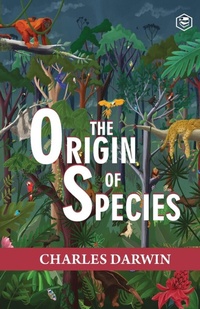
The Origin of Species
Published on 4. May 2021
Book
Paperback/Softback
480 pages
978-93-90896-44-8 (ISBN)
Description
The Origin of Species is a work of scientific literature by Charles Darwin which is considered to be the foundation of evolutionary biology. The contents of the book were severely backed by Darwinian evidence, which gave it its authenticity and is now considered a pioneering work in effect for the study of modern evolution theory. The survival of the fittest is a theory every person is familiar with, as it is often used as an expression in generic situations. Charles Darwin proposed a theory that contains his views on population size and the species in general. Some of the key features of this book are the building blocks of society. Some of these are as follows: each population size remains almost the same over time, species have to struggle in order to survive and individuals belonging to the same species differ significantly.
The Origin of Species includes several examples and accounts that led to this Darwinian school of thought besides the theory itself.
More details
Language
English
Place of publication
India
Dimensions
Height: 216 mm
Width: 140 mm
Thickness: 28 mm
Weight
671 gr
ISBN-13
978-93-90896-44-8 (9789390896448)
Copyright in bibliographic data and cover images is held by Nielsen Book Services Limited or by the publishers or by their respective licensors: all rights reserved.
Schweitzer Classification
Persons
Charles Darwin (1809-1882) was an English naturalist and geologist whose pioneering work laid the foundation for modern evolutionary biology. His seminal book, "On the Origin of Spe cies," introduced the theory of natural selection, revolutionizing our understanding of the development of life on Earth. Darwin's meticulous observations and extensive research during his voy age on the HMS Beagle provided critical insights into the mech anisms of evolution and the interconnectedness of species. His groundbreaking ideas challenged established beliefs and continue to influence scientific thought and discourse, cementing his lega cy as one of history's most influential scientists.