

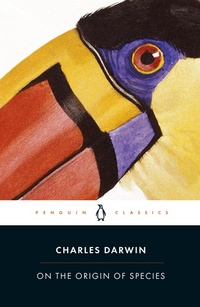
On the Origin of Species
By Means of Natural Selection or The Preservation of Favoured Races in the Struggle for Life
Published on 3. September 2009
Book
Paperback/Softback
576 pages
978-0-14-043912-0 (ISBN)
Description
Charles Darwin's seminal formulation of the theory of Evolution, On the Origin of Species continues to be as controversial today as when it was first published. This Penguin Classics edition contains an introduction and notes by William Bynum, and features a cover designed by Damien Hirst.
Written for a general readership, On the Origin of Species sold out on the day of its publication and has remained in print ever since. Instantly and persistently controversial, the concept of natural selection transformed scientific analysis about all life on Earth. Before the Origin of Species, accepted thinking held that life was the static and perfect creation of God. By a single, systematic argument Darwin called this view into question. His ideas have affected public perception of everything from religion to economics.
William Bynum's introduction discusses Darwin's life, the publication and reception of the themes of On the Origin of Species, and the subsequent development of its major themes. The new edition also includes brief biographies of some of the most important scientific thinkers leading up to and surrounding the Origin of Species, suggested further reading, notes and a chronology.
Charles Darwin (1809-82), a Victorian scientist and naturalist, has become one of the most famous figures of science to date. The advent of On the Origin of Species by Means of Natural Selection in 1859 challenged and contradicted all contemporary biological and religious beliefs.
If you enjoyed On the Origin of Species, you might like Darwin's The Descent of Man, also available in Penguin Classics.
Written for a general readership, On the Origin of Species sold out on the day of its publication and has remained in print ever since. Instantly and persistently controversial, the concept of natural selection transformed scientific analysis about all life on Earth. Before the Origin of Species, accepted thinking held that life was the static and perfect creation of God. By a single, systematic argument Darwin called this view into question. His ideas have affected public perception of everything from religion to economics.
William Bynum's introduction discusses Darwin's life, the publication and reception of the themes of On the Origin of Species, and the subsequent development of its major themes. The new edition also includes brief biographies of some of the most important scientific thinkers leading up to and surrounding the Origin of Species, suggested further reading, notes and a chronology.
Charles Darwin (1809-82), a Victorian scientist and naturalist, has become one of the most famous figures of science to date. The advent of On the Origin of Species by Means of Natural Selection in 1859 challenged and contradicted all contemporary biological and religious beliefs.
If you enjoyed On the Origin of Species, you might like Darwin's The Descent of Man, also available in Penguin Classics.
More details
Language
English
Place of publication
London
United Kingdom
Publishing group
Penguin Books Ltd
Target group
College/higher education
Professional and scholarly
Product notice
Paperback (UK-B)
Dimensions
Height: 200 mm
Width: 130 mm
Thickness: 35 mm
Weight
406 gr
ISBN-13
978-0-14-043912-0 (9780140439120)
Copyright in bibliographic data and cover images is held by Nielsen Book Services Limited or by the publishers or by their respective licensors: all rights reserved.
Schweitzer Classification
Other editions
Additional editions
Charles Darwin | Natalie Ramm
On the Origin of Species
E-Book
09/2009
1st Edition
Penguin Books Ltd
€8.49
Available for download
Book
01/1964
Harvard University Press
€32.50
Shipment within 15-20 days
Previous edition
Charles Darwin | J. Burrow
The Origin of Species by Means of Natural Selection
Or the Preservation of Favoured Races in the Struggle for Life
Book
07/1982
Penguin Classics
€32.39
Article exhausted; check for reprint
Persons
Charles Darwin (Author)
Charles Darwin, a Victorian scientist and naturalist, has become one of the most famous figures of science to date. Born in 1809 to an upper-middle-class medical family, he was destined for a career in either medicine or the Anglican Church. However, he never completed his medical education and his future changed entirely in 1831 when he joined HMS Beagle as a self-financing, independent naturalist. On returning to England in 1836 he began to write up his theories and observations which culminated in a series of books, most famously On the Origin of Species by Means of Natural Selection in 1859, where he challenged and contradicted contemporary biological and religious beliefs with two decades worth of scientific investigation and theory. Darwin's theory of natural selection is now the most widely accepted scientific model of how species evolve. He died in 1882 and was buried in Westminster Abbey.
William Bynum (External Editor, Introducer)
William Bynum is Professor Emeritus of the History of Medicine at University College, London, and was for many years Head of the Academic Unit of the Wellcome Institute for the History of Medicine. He edited the scholarly journal Medical History from 1980 to 2001, and his previous publications include Science and the Practice of Medicine in the Nineteenth Century; The Companion Encyclopedia of the History of Medicine (co-edited with Roy Porter); The Oxford Dictionary of Scientific Quotations (with Roy Porter), The Dictionary of Medical Biography (with Helen Bynum), and History of Medicine: A Very Short Introduction. He lives in Suffolk.
Charles Darwin, a Victorian scientist and naturalist, has become one of the most famous figures of science to date. Born in 1809 to an upper-middle-class medical family, he was destined for a career in either medicine or the Anglican Church. However, he never completed his medical education and his future changed entirely in 1831 when he joined HMS Beagle as a self-financing, independent naturalist. On returning to England in 1836 he began to write up his theories and observations which culminated in a series of books, most famously On the Origin of Species by Means of Natural Selection in 1859, where he challenged and contradicted contemporary biological and religious beliefs with two decades worth of scientific investigation and theory. Darwin's theory of natural selection is now the most widely accepted scientific model of how species evolve. He died in 1882 and was buried in Westminster Abbey.
William Bynum (External Editor, Introducer)
William Bynum is Professor Emeritus of the History of Medicine at University College, London, and was for many years Head of the Academic Unit of the Wellcome Institute for the History of Medicine. He edited the scholarly journal Medical History from 1980 to 2001, and his previous publications include Science and the Practice of Medicine in the Nineteenth Century; The Companion Encyclopedia of the History of Medicine (co-edited with Roy Porter); The Oxford Dictionary of Scientific Quotations (with Roy Porter), The Dictionary of Medical Biography (with Helen Bynum), and History of Medicine: A Very Short Introduction. He lives in Suffolk.