

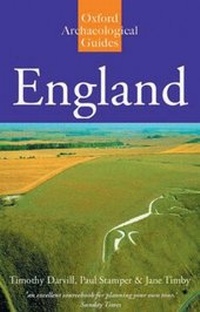
England
An Archaeological Guide to Sites from earliest Times to AD 1600
Published on 14. March 2002
Book
Paperback/Softback
524 pages
978-0-19-284101-8 (ISBN)
Description
Travelling around England is in many senses a journey back in time. On all sides, and sometimes even under the road or footpath itself, there are fragments of the ancient past side by side with the clutter of the modern world. Medieval villages, castles, ancient churches, and Roman villas are commonplace and take us back to the time of Christ. Far older, yet equally abundant, are the barrows, hillforts, stone circles, camps, standing stones, trackways, and other relics of prehistoric times that have survived for several thousand years.
This Guide is all about these ancient remains: the prehistoric, Roman, and medieval sites which date from the time between the first appearance of people in what we now call England during the last Ice Age and the end of medieval times around 1600 AD.
This Guide is all about these ancient remains: the prehistoric, Roman, and medieval sites which date from the time between the first appearance of people in what we now call England during the last Ice Age and the end of medieval times around 1600 AD.
More details
Series
Language
English
Place of publication
Oxford
United Kingdom
Illustrations
numerous maps, plans, line drawings and halftones
Dimensions
Height: 215 mm
Width: 139 mm
Thickness: 32 mm
Weight
639 gr
ISBN-13
978-0-19-284101-8 (9780192841018)
Copyright in bibliographic data and cover images is held by Nielsen Book Services Limited or by the publishers or by their respective licensors: all rights reserved.
Schweitzer Classification
Persons
Timothy Darvill is Professor of Archaeology in the School of Conservation Sciences at Bournemouth University. The author of over a dozen books, including Prehistoric Britain (Routledge, 1998) and Prehistoric Britain from the Air (CUP, 1996), he has served as Chairman of the Institute of Field Archaeologists and a Member of the Council of the National Trust.
Jane Timby is a freelance arcaheological consultant specializing in later prehistoric, Roman, and Saxon pottery. She has published numerous articles and specialist studies and was the author of The Anglo-Saxon Cemetery at Empingham II, Rutland (Oxbow Books, 1996) and Excavations at Kingscote and Wycomb, Gloucestershire (Cotswold Archaeological Trust, 1998).
Paul Stamper is an Inspector of Ancient Monuments for English Heritage, working in the west midlands. Formerly he was involved with the compilation of the Register of Historic Parks and Gardens in England. Before 1993 he was an editor with the Victoria County History of Shropshire. He has published widely on landscape history, and has served as Secretary of the Society for Medieval Archaeology.
Jane Timby is a freelance arcaheological consultant specializing in later prehistoric, Roman, and Saxon pottery. She has published numerous articles and specialist studies and was the author of The Anglo-Saxon Cemetery at Empingham II, Rutland (Oxbow Books, 1996) and Excavations at Kingscote and Wycomb, Gloucestershire (Cotswold Archaeological Trust, 1998).
Paul Stamper is an Inspector of Ancient Monuments for English Heritage, working in the west midlands. Formerly he was involved with the compilation of the Register of Historic Parks and Gardens in England. Before 1993 he was an editor with the Victoria County History of Shropshire. He has published widely on landscape history, and has served as Secretary of the Society for Medieval Archaeology.
Content
INTRODUCTION ; REFERENCE SECTION