

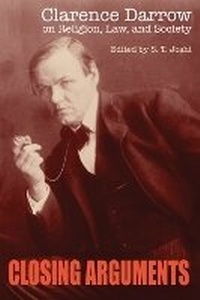
Closing Arguments
Clarence Darrow on Religion, Law, and Society
Published on 15. August 2005
Book
Hardback
272 pages
978-0-8214-1632-7 (ISBN)
Description
Clarence Darrow, son of a village undertaker and coffinmaker, rose to become one of America's greatest attorneys-and surely its most famous. The Ohio native gained renown for his central role in momentous trials, including his 1924 defense of Leopold and Loeb and his defense of Darwinian principles in the 1925 Scopes "Monkey Trial." Some have traced Darrow's lifelong campaign against capital punishment to his boyhood terror at seeing a Civil War soldier buried-and no client of Darrow's was ever executed, not even black men who were accused of murder for killing members of a white mob.
Closing Arguments: Clarence Darrow on Religion, Law, and Society collects, for the first time, Darrow's thoughts on his three main preoccupations, revealing a carefully conceived philosophy expressed with delightful pungency and clarity. His thoughts on social issues, especially on the dangers of religious fundamentalism, are uncannily prescient. A dry humor infuses his essays, and his reflections on himself and his philosophy reveal a quiet dignity at the core of a man better known for provoking Americans during an era of unprecedented tumult. From the wry "Is the Human Race Getting Anywhere?" to the scornful "Patriotism" and his elegiac summing up, "At Seventy-two," Darrow's writing still stimulates, pleases and challenges.
A rebel who always sided intellectually and emotionally with the minority, Darrow remains a figure to contend with sixty-seven years after his death. "Inside every lawyer is the wreck of a poet," Darrow once said. Closing Arguments demonstrates that, in his case, that statement is true.
Closing Arguments: Clarence Darrow on Religion, Law, and Society collects, for the first time, Darrow's thoughts on his three main preoccupations, revealing a carefully conceived philosophy expressed with delightful pungency and clarity. His thoughts on social issues, especially on the dangers of religious fundamentalism, are uncannily prescient. A dry humor infuses his essays, and his reflections on himself and his philosophy reveal a quiet dignity at the core of a man better known for provoking Americans during an era of unprecedented tumult. From the wry "Is the Human Race Getting Anywhere?" to the scornful "Patriotism" and his elegiac summing up, "At Seventy-two," Darrow's writing still stimulates, pleases and challenges.
A rebel who always sided intellectually and emotionally with the minority, Darrow remains a figure to contend with sixty-seven years after his death. "Inside every lawyer is the wreck of a poet," Darrow once said. Closing Arguments demonstrates that, in his case, that statement is true.
Reviews / Votes
"Darrow's Closing Arguments are, even today, clear, forceful and prescient. What a treasure. Entertaining and educational. A timely reminder that the more things change, the more they remain the same." "A thought-provoking glimpse of one of the most original minds in American history."More details
Language
English
Place of publication
Athens
United States
Target group
College/higher education
Professional and scholarly
Product notice
Paper over boards
Dimensions
Height: 229 mm
Width: 152 mm
ISBN-13
978-0-8214-1632-7 (9780821416327)
Copyright in bibliographic data and cover images is held by Nielsen Book Services Limited or by the publishers or by their respective licensors: all rights reserved.
Schweitzer Classification
Persons
S. T. Joshi has edited several collections of Mencken's writings, including H. L. Mencken on American Literature, Mencken's America, and Mencken on Mencken: A New Collection of Autobiographical Writings. He is also an authority on literature of the supernatural and author of The Weird Tale, Unutterable Horror: A History of Supernatural Fiction, and other critical and biographical studies.