

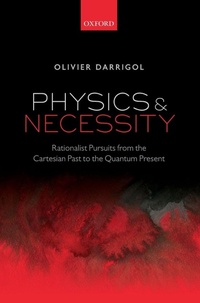
Physics and Necessity
Rationalist Pursuits from the Cartesian Past to the Quantum Present
Published on 22. May 2014
Book
Hardback
418 pages
978-0-19-871288-6 (ISBN)
Description
Can we prove the necessity of our best physical theories by rational means, without appeal to experience? This book recounts a few ingenious attempts to derive physical theories by reason only, beginning with Descartes' geometric construction of the world, and finishing with recent derivations of quantum mechanics from natural axioms. Deductions based on theological, metaphysical, or transcendental arguments are worth remembering for the ways they motivated and structured physical theory, even though we would now criticize their excessive confidence in the power of the mind. Other deductions more modestly relied on criteria for the comprehensibility of nature, including forms of measurability, causality, homogeneity, and correspondence. The central thesis of this book is that such criteria, when properly applied to idealized systems, effectively determine some of our most important theories as well as the mathematical character of the laws of physics. The relevant arguments are not purely rational, because only experience can tell us to which extent nature is comprehensible in a given way. Nor do they block the possibility of ever more varied forms of comprehensibility. They nonetheless suggest the inevitability of much of our theoretical physics.
Reviews / Votes
The idea that we can establish foundational principles of physical theories on pure reason alone did not die with Newtons rejection of Cartesian rationalism. Darrigol, the author of a number of valuable works on the history of physics, explores latter day rationalisms, focusing on those that follow Helmholtz in seeking for necessary conditions on the interpretation and application of theories. Darrigol offers his own account on how theories must be interpreted and applied and how the necessity for these may very well be taken as establishing a limited kind of rational support for some principles of foundational physics. * Lawrence Sklar, University of Michigan * In this excellently written book, Darrigol steps back to survey the history of necessity in physics, and the richness of the necessitarian programme despite that programme's (sometimes embarrassing) trail of failures. What he shows is the persistence of the belief in a rational and comprehensible universe and the importance of that belief for the development of empirical science --- whatever sober, empirical reservations come in to philosophical fashion. Reading this book may remind us all why we were interested in philosophy in the first place. * Brian Hepburn, Aarhus University *More details
Language
English
Place of publication
Oxford
United Kingdom
Target group
College/higher education
Professional and scholarly
Illustrations
37 b/w illustrations
Dimensions
Height: 250 mm
Width: 175 mm
Thickness: 27 mm
Weight
897 gr
ISBN-13
978-0-19-871288-6 (9780198712886)
Copyright in bibliographic data and cover images is held by Nielsen Book Services Limited or by the publishers or by their respective licensors: all rights reserved.
Schweitzer Classification
Other editions
Additional editions
Olivier Darrigol
Physics and Necessity
Rationalist Pursuits from the Cartesian Past to the Quantum Present
E-Book
05/2014
1st Edition
OUP eBook
€57.99
Available for download
Person
Olivier Darrigol studied physics at the Ecole Normale Superieure in Paris, the history and philosophy of physics at the Sorbonne and at UC-Berkeley's Office for History of Science and Technology (OHST). He is the author of several books on the history of quantum physics, electrodynamics, hydrodynamics, and optics. He is currently a member of the SPHere research team at CNRS/Paris 7, and a Research Associate at UC-Berkeley's OHST.
Content
1. Rationalism in the history of mechanics ; 2. The necessity of classical mechanics ; 3. From mechanical reduction to general principles ; 4. Geometry ; 5. Spacetime ; 6. Numbers and math ; 7. Classical field theories ; 8. Quantum mechanics ; 9. Necessity, theories, and modules