

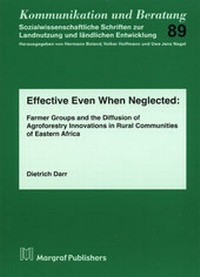
Effective even when neglected
Farmer groups and the diffusion of agroforestry innovations in rural communities of Eastern Africa
Published on 4. February 2009
Book
Paperback/Softback
XIV, 164 pages
978-3-8236-1554-5 (ISBN)
Description
The purpose of this book is to explore the contribution of development-oriented farmer groups to the diffusion of innovations in rural communities of Kenya and Ethiopia, and to identify major key drivers of effective innovation diffusion. The research is based on the comparative assessment of four peasant communities that differ in terms of the prevail-ing extension approach and model of farmer group governance.
A profound review of four theoretical frameworks serves to develop a multiple-pathway model of innovation diffusion that amalgamates major concepts of the social network and functional group theories.
The findings illustrate that farmers, through their group and non-group networks and under group-oriented and individual extension alike, exchange information, knowledge, and social pressures that shape their individual adoption decisions. Yet, innovations tend to disseminate more effectively in farmer groups vis-à-vis non-group networks, and the groups tend to be more effective when addressed by extension agents.
The research reveals that the advantage of farmer groups can be attributed to their di-morphic character that combines the bridging and bonding effects of 'weak' and 'strong' ties. By facilitating the emergence of cohesive relationships among the group members and by simultaneously enhancing the members' exposure to external information sour-ces group-oriented extension work considerably contributes to foster the diffusion of innovations among farmers.
Recommendations refer to the improvement of extension practice and directions for fu-ture research.
A profound review of four theoretical frameworks serves to develop a multiple-pathway model of innovation diffusion that amalgamates major concepts of the social network and functional group theories.
The findings illustrate that farmers, through their group and non-group networks and under group-oriented and individual extension alike, exchange information, knowledge, and social pressures that shape their individual adoption decisions. Yet, innovations tend to disseminate more effectively in farmer groups vis-à-vis non-group networks, and the groups tend to be more effective when addressed by extension agents.
The research reveals that the advantage of farmer groups can be attributed to their di-morphic character that combines the bridging and bonding effects of 'weak' and 'strong' ties. By facilitating the emergence of cohesive relationships among the group members and by simultaneously enhancing the members' exposure to external information sour-ces group-oriented extension work considerably contributes to foster the diffusion of innovations among farmers.
Recommendations refer to the improvement of extension practice and directions for fu-ture research.