

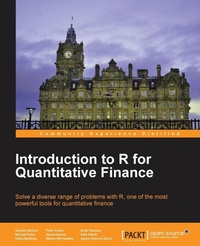
Introduction to R for Quantitative Finance
R is a statistical computing language that's ideal for answering quantitative finance questions. This book gives you both theory and practice, all in clear language with stacks of real-world examples. Ideal for R beginners or expert alike.
Published on 22. November 2013
Book
Paperback/Softback
164 pages
978-1-78328-093-3 (ISBN)
Description
R is a statistical computing language that s ideal for answering quantitative finance questions. This book gives you both theory and practice, all in clear language with stacks of real-world examples. Ideal for R beginners or expert alike.
Key Features
Use time series analysis to model and forecast house prices
Estimate the term structure of interest rates using prices of government bonds
Detect systemically important financial institutions by employing financial network analysis
Book DescriptionIntroduction to R for Quantitative Finance will show you how to solve real-world quantitative fi nance problems using the statistical computing language R. The book covers diverse topics ranging from time series analysis to fi nancial networks. Each chapter briefl y presents the theory behind specific concepts and deals with solving a diverse range of problems using R with the help of practical examples.This book will be your guide on how to use and master R in order to solve quantitative finance problems. This book covers the essentials of quantitative finance, taking you through a number of clear and practical examples in R that will not only help you to understand the theory, but how to effectively deal with your own real-life problems.Starting with time series analysis, you will also learn how to optimize portfolios and how asset pricing models work. The book then covers fixed income securities and derivatives such as credit risk management.What you will learn
How to model and forecast house prices and improve hedge ratios using cointegration and model volatility
How to understand the theory behind portfolio selection and how it can be applied to real-world data
How to utilize the Capital Asset Pricing Model and the Arbitrage Pricing Theory
How to understand the basics of fixed income instruments
You will discover how to use discrete- and continuous-time models for pricing derivative securities
How to successfully work with credit default models and how to model correlated defaults using copulas
How to understand the uses of the Extreme Value Theory in insurance and fi nance, model fitting, and risk measure calculation
Who this book is forIf you are looking to use R to solve problems in quantitative finance, then this book is for you. A basic knowledge of financial theory is assumed, but familiarity with R is not required. With a focus on using R to solve a wide range of issues, this book provides useful content for both the R beginner and more experience users.
Key Features
Use time series analysis to model and forecast house prices
Estimate the term structure of interest rates using prices of government bonds
Detect systemically important financial institutions by employing financial network analysis
Book DescriptionIntroduction to R for Quantitative Finance will show you how to solve real-world quantitative fi nance problems using the statistical computing language R. The book covers diverse topics ranging from time series analysis to fi nancial networks. Each chapter briefl y presents the theory behind specific concepts and deals with solving a diverse range of problems using R with the help of practical examples.This book will be your guide on how to use and master R in order to solve quantitative finance problems. This book covers the essentials of quantitative finance, taking you through a number of clear and practical examples in R that will not only help you to understand the theory, but how to effectively deal with your own real-life problems.Starting with time series analysis, you will also learn how to optimize portfolios and how asset pricing models work. The book then covers fixed income securities and derivatives such as credit risk management.What you will learn
How to model and forecast house prices and improve hedge ratios using cointegration and model volatility
How to understand the theory behind portfolio selection and how it can be applied to real-world data
How to utilize the Capital Asset Pricing Model and the Arbitrage Pricing Theory
How to understand the basics of fixed income instruments
You will discover how to use discrete- and continuous-time models for pricing derivative securities
How to successfully work with credit default models and how to model correlated defaults using copulas
How to understand the uses of the Extreme Value Theory in insurance and fi nance, model fitting, and risk measure calculation
Who this book is forIf you are looking to use R to solve problems in quantitative finance, then this book is for you. A basic knowledge of financial theory is assumed, but familiarity with R is not required. With a focus on using R to solve a wide range of issues, this book provides useful content for both the R beginner and more experience users.
More details
Language
English
Place of publication
Birmingham
United Kingdom
Dimensions
Height: 235 mm
Width: 191 mm
Thickness: 10 mm
Weight
320 gr
ISBN-13
978-1-78328-093-3 (9781783280933)
Copyright in bibliographic data and cover images is held by Nielsen Book Services Limited or by the publishers or by their respective licensors: all rights reserved.
Schweitzer Classification
Other editions
Additional editions
Gergely Daroczi | Michael Phule | Edina Berlinger (EURO)
Introduction to R for Quantitative Finance
R is a statistical computing language that's ideal for answering quantitative finance questions. This book gives you both theory and practice, all in clear language with stacks of real-world examples. Ideal for R beginners or expert alike.
E-Book
01/2025
Packt Publishing
from
€31.19
Available for download
Persons
Gergely Darczi is a former assistant professor of statistics and an enthusiastic R user and package developer. He is the founder and CTO of an R-based reporting web application at http://rapporter.net and a PhD candidate in sociology. He is currently working as the lead R developer/research data scientist at https://www.card.com/ in Los Angeles. Besides maintaining around half a dozen R packages, mainly dealing with reporting, Gergely has coauthored the books Introduction to R for Quantitative Finance and Mastering R for Quantitative Finance (both by Packt Publishing) by providing and reviewing the R source code. He has contributed to a number of scientific journal articles, mainly in social sciences but in medical sciences as well. Michael Puhle obtained a Ph.D. in Finance from the University of Passau in Germany. He worked for several years as a Senior Risk Controller at Allianz Global Investors in Munich, and as an Assistant Manager at KPMG's Financial Risk Management practice, where he was advising banks on market risk models. Michael is also the author of Bond Portfolio Optimization published by Springer Publishing. Edina Berlinger has a PhD in economics from the Corvinus University of Budapest. She is an associate professor, teaching corporate finance, investments, and financial risk management. She is the head of the Finance department of the university, and is also the chair of the finance subcommittee of the Hungarian Academy of Sciences. Her expertise covers loan systems, risk management, and more recently, network analysis. She has led several research projects in student loan design, liquidity management, heterogeneous agent models, and systemic risk. Peter Csoka is an Associate Professor at the Department of Finance, Corvinus University of Budapest, and a research fellow in the Game Theory Research Group, Centre For Economic and Regional Studies, Hungarian Academy of Sciences. He received his Ph.D. in Economics from Maastricht University in 2008. His research topics include risk measures, risk capital allocation, game theory, corporate finance, and general equilibrium theory. He is currently focused on analyzing risk contributions for systemic risk and for illiquid portfolios. He has papers published in journals such as Mathematical Methods of Operational Research, European Journal of Operational Research, Games and Economic Behaviour, and Journal of Banking and Finance. He is the Chair of the organizing committee of the Annual Financial Market Liquidity Conference in Budapest. Daniel Havran is a postdoctoral research fellow at Institute of Economics, Centre for Economic and Regional Studies, Hungarian Academy of Sciences. He also holds a part-time assistant professor position at the Corvinus University of Budapest, where he teaches corporate finance (BA, PhD) and credit risk management (MSc). He obtained his PhD in economics at Corvinus University of Budapest in 2011. Marton Michaletzky obtained his Ph.D. degree in Economics in 2011 from Corvinus University of Budapest. Between 2000 and 2003, he has been a Risk Manager and Macroeconomic Analyst with Concorde Securities Ltd. As Capital Market Transactions Manager, he gained experience in an EUR 3 bn securitization at the Hungarian State Motorway Management Company. In 2012, he took part in the preparation of an IPO and the private placement of a Hungarian financial services provider. Prior to joining DBH Investment, he was an assistant professor at the Department of Finance of CUB. Zsolt Tulassay works as a Quantitative Analyst at a major US investment bank, validating derivatives pricing models. Previously, Zsolt worked as an Assistant Lecturer at the Department of Finance at Corvinus University, teaching courses on Derivatives, Quantitative Risk Management, and Financial Econometrics. Zsolt holds MA degrees in Economics from Corvinus University of Budapest and Central European University. His research interests include derivatives pricing, yield curve modeling, liquidity risk, and heterogeneous agent models. Kata Vradi is an assistant professor at the Department of Finance, Corvinus University of Budapest since 2013. Kata graduated in finance in 2009 from Corvinus University of Budapest and was awarded a PhD degree in 2012 for her thesis on the analysis of the market liquidity risk on the Hungarian stock market. Her research areas are market liquidity, fixed income securities, and networks in healthcare systems. Besides doing research, she is active in teaching as well. She mainly teaches corporate finance, investments, valuation, and multinational financial management. Agnes Vidovics-Dancs is a PhD candidate and an assistant professor at the Department of Finance, Corvinus University of Budapest. Previously, she worked as a junior risk manager in the Hungarian Government Debt Management Agency. Her main research areas are government debt management (in general) and sovereign crises and defaults (in particular). She is a CEFA and CIIA diploma holder.
Agnes Vidovics-Dancs is a PhD candidate and an assistant professor at the Department of Finance, Corvinus University of Budapest. Previously, she worked as a junior risk manager in the Hungarian Government Debt Management Agency. Her main research areas are government debt management (in general) and sovereign crises and defaults (in particular). She is a CEFA and CIIA diploma holder.
Agnes Vidovics-Dancs is a PhD candidate and an assistant professor at the Department of Finance, Corvinus University of Budapest. Previously, she worked as a junior risk manager in the Hungarian Government Debt Management Agency. Her main research areas are government debt management (in general) and sovereign crises and defaults (in particular). She is a CEFA and CIIA diploma holder.
Content
Table of Contents