

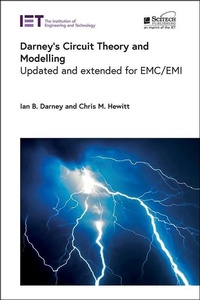
Darney's Circuit Theory and Modelling
Updated and extended for EMC/EMI
Published on 5. March 2024
Book
Hardback
314 pages
978-1-83953-953-4 (ISBN)
Description
The equipotential earth is a fundamental requirement of circuit theory, because it dramatically reduces the complexity of the mathematics required to simulate a circuit. Unfortunately, in the real world, no such equipotential earth exists, nor can it ever do so, which means simulating a circuit to evaluate its electromagnetic compatibility (EMC) and susceptibility to electromagnetic interference (EMI) is largely dependent on using the Maxwell equations. The Maxwell equations are inherently complex, however, and so have high processing power requirements and, as with all complex systems, there is a propensity to generate and magnify errors.
Fortunately, the models provided in this book require far less processing power, as the mathematics required is far less complex than that of the Maxwell equations. These models are explained in a simple and straightforward manner, and can be used at the developmental stage of a project and redeployed in the testing stage before the manufacturing and product deployment stages are implemented.
A review of the relationship of circuit theory with electromagnetic theory identifies a way of augmenting these analytical tools, and this enables circuit models to be developed to simulate all forms of EMI, thus effectively updating and extending circuit theory.
The technique described in this book can be used to analyse all the mechanisms involved in the propagation of EMI. This approach avoids the need for endless debate on the topic of ground philosophy. Equally, it avoids the need to invoke the complexities of electromagnetic computation.
The book is aimed at electrical and electronic design engineers and EMI/EMC design consultants.
Fortunately, the models provided in this book require far less processing power, as the mathematics required is far less complex than that of the Maxwell equations. These models are explained in a simple and straightforward manner, and can be used at the developmental stage of a project and redeployed in the testing stage before the manufacturing and product deployment stages are implemented.
A review of the relationship of circuit theory with electromagnetic theory identifies a way of augmenting these analytical tools, and this enables circuit models to be developed to simulate all forms of EMI, thus effectively updating and extending circuit theory.
The technique described in this book can be used to analyse all the mechanisms involved in the propagation of EMI. This approach avoids the need for endless debate on the topic of ground philosophy. Equally, it avoids the need to invoke the complexities of electromagnetic computation.
The book is aimed at electrical and electronic design engineers and EMI/EMC design consultants.
More details
Series
Language
English
Place of publication
Stevenage
United Kingdom
Target group
College/higher education
Professional and scholarly
Product notice
sewn/stitched
Cloth over boards
Dimensions
Height: 234 mm
Width: 156 mm
Thickness: 19 mm
Weight
617 gr
ISBN-13
978-1-83953-953-4 (9781839539534)
Copyright in bibliographic data and cover images is held by Nielsen Book Services Limited or by the publishers or by their respective licensors: all rights reserved.
Schweitzer Classification
Other editions
New editions
Ian B. Darney | Chris M. Hewitt
Darney's Circuit Modelling for Electromagnetic Compatibility
Book
approx. 12/2025
2nd Edition
Institution of Engineering and Technology
€143.50
Not yet published
Persons
Ian B. Darney (deceased) was a graduate of Glasgow University, UK. A highly knowledgeable electrical engineer, Mr Darney had extensive experience of EMC, particularly in the aircraft industry. He was a member of the IET and the European Organisation for Civil Aviation Equipment (EUROCAE).
Chris M. Hewitt is an autonomous agent design engineer with nine years' HMRAF experience installing, repairing and calibrating radar and missile systems, alongside test and communication equipment. He is a recipient of the Support Command Certificate of Merit for 'Initiative and Inventiveness towards the improvement of engineering services of the RAF', with extensive knowledge of EMC/EMI. His current focus is on developing the AE42 concept; a gravity centric and empirical data approach to grand unification.
Chris M. Hewitt is an autonomous agent design engineer with nine years' HMRAF experience installing, repairing and calibrating radar and missile systems, alongside test and communication equipment. He is a recipient of the Support Command Certificate of Merit for 'Initiative and Inventiveness towards the improvement of engineering services of the RAF', with extensive knowledge of EMC/EMI. His current focus is on developing the AE42 concept; a gravity centric and empirical data approach to grand unification.
Content
Chapter 1: Introduction
Chapter 2: Cross coupling models
Chapter 3: Multi-conductor models
Chapter 4: Antenna models
Chapter 5: Transient analysis
Chapter 6: Three conductor transient models
Chapter 7: Further EMC/EMI research
Appendix A: Inductance and capacitance primitives
Appendix B: Mathcad worksheets
Appendix C: Links to Internet resources and references
Appendix D: Definitions
Chapter 2: Cross coupling models
Chapter 3: Multi-conductor models
Chapter 4: Antenna models
Chapter 5: Transient analysis
Chapter 6: Three conductor transient models
Chapter 7: Further EMC/EMI research
Appendix A: Inductance and capacitance primitives
Appendix B: Mathcad worksheets
Appendix C: Links to Internet resources and references
Appendix D: Definitions