

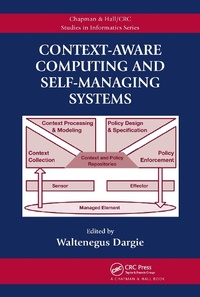
Context-Aware Computing and Self-Managing Systems
1st Edition
Published on 25. March 2009
Book
Hardback
408 pages
978-1-4200-7771-1 (ISBN)
Description
Bringing together an extensively researched area with an emerging research issue, Context-Aware Computing and Self-Managing Systems presents the core contributions of context-aware computing in the development of self-managing systems, including devices, applications, middleware, and networks. The expert contributors reveal the usefulness of context-aware computing in developing autonomous systems that have practical application in the real world.
The first chapter of the book identifies features that are common to both context-aware computing and autonomous computing. It offers a basic definition of context-awareness, covers fundamental aspects of self-managing systems, and provides several examples of context information and self-managing systems. Subsequent chapters on context-awareness demonstrate how a context can be employed to make systems smart, how a context can be captured and represented, and how dynamic binding of context sources can be possible. The chapters on self-management illustrate the need for "implicit knowledge" to develop fault-tolerant and self-protective systems. They also present a higher-level vision of future large-scale networks.
Through various examples, this book shows how context-aware computing can be used in many self-managing systems. It enables researchers of context-aware computing to identify potential applications in the area of autonomous computing. The text also supports researchers of autonomous computing in defining, modeling, and capturing dynamic aspects of self-managing systems.
The first chapter of the book identifies features that are common to both context-aware computing and autonomous computing. It offers a basic definition of context-awareness, covers fundamental aspects of self-managing systems, and provides several examples of context information and self-managing systems. Subsequent chapters on context-awareness demonstrate how a context can be employed to make systems smart, how a context can be captured and represented, and how dynamic binding of context sources can be possible. The chapters on self-management illustrate the need for "implicit knowledge" to develop fault-tolerant and self-protective systems. They also present a higher-level vision of future large-scale networks.
Through various examples, this book shows how context-aware computing can be used in many self-managing systems. It enables researchers of context-aware computing to identify potential applications in the area of autonomous computing. The text also supports researchers of autonomous computing in defining, modeling, and capturing dynamic aspects of self-managing systems.
More details
Language
English
Place of publication
Oxford
United Kingdom
Publishing group
Taylor & Francis Ltd
Target group
Professional and scholarly
Professional Practice & Development
Product notice
Paper over boards
Dimensions
Height: 241 mm
Width: 162 mm
Thickness: 27 mm
Weight
716 gr
ISBN-13
978-1-4200-7771-1 (9781420077711)
Copyright in bibliographic data and cover images is held by Nielsen Book Services Limited or by the publishers or by their respective licensors: all rights reserved.
Schweitzer Classification
Other editions
Additional editions
Waltenegus Dargie
Context-Aware Computing and Self-Managing Systems
Book
10/2019
1st Edition
Chapman & Hall/CRC
€76.81
Shipment within 15-20 days
Waltenegus Dargie
Context-Aware Computing and Self-Managing Systems
E-Book
03/2009
Chapman and Hall
€86.99
Available for download
Waltenegus Dargie
Context-Aware Computing and Self-Managing Systems
E-Book
03/2009
1st Edition
Chapman & Hall/CRC
€86.99
Available for download
Person
Waltenegus Dargie
Content
The Role of Context-Aware Computing in Developing Self-Managing Systems. Verifying Nursing Activities Based on Workflow Model. A Taxonomy of Service Discovery Systems. Managing Distributed and Heterogeneous Context for Ambient Intelligence. Dynamic Content Negotiation in Web Environments. The Road toward Self-Management in Communication Networks. Policy-Based Self-Management in Wireless Networks. Autonomous Machine Learning Networks. Probabilistic Fault Management.