

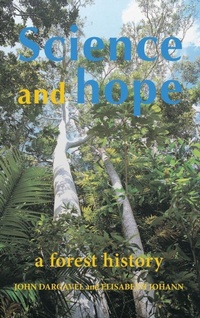
Science and Hope
A Forest History
Published on 1. June 2013
Book
Hardback
278 pages
978-1-874267-73-7 (ISBN)
Description
This book tells the story of the hopeful science and trusting art of forestry. It is a story about the hopes of foresters and other scientists to understand the forests more deeply, and about their unspoken trust that their knowledge could ensure an enduring sylvan future. Much has been written on the origins and development of modern forestry in various countries, and on the people and institutions involved, but there is little in the forest history literature that explains what the science actually is. Forest knowledge has an ancient history documented since classical times and applied within the intricate social and legal systems of medieval Europe. This volume is concerned with the modern form of forest science, founded in Europe early in the nineteenth century, when regimes for managing the forests, that could be traced to the ancient world and had flourished in the Middle Ages, were disrupted. New ways had to be found. Foresters have tried to know their forests scientifically for over three centuries and have hoped to apply their knowledge to good effect, even though they could not live to see the futures they envisioned.
How far did their scientific understanding enable a sylvan future? What, over the three centuries discussed in this book, were their successes and failures? And now what might the future hold for forest science and its application? This is no tale of triumph: the outlook for the world's forests is too bleak for that. While many forests are flourishing, the climate is changing, tropical forests are disappearing, others are degrading, species are being lost, governments dither, international conferences fail. This is another, longer story - one of inquiry, of science and persistent endeavour to find a better future for the forests.
How far did their scientific understanding enable a sylvan future? What, over the three centuries discussed in this book, were their successes and failures? And now what might the future hold for forest science and its application? This is no tale of triumph: the outlook for the world's forests is too bleak for that. While many forests are flourishing, the climate is changing, tropical forests are disappearing, others are degrading, species are being lost, governments dither, international conferences fail. This is another, longer story - one of inquiry, of science and persistent endeavour to find a better future for the forests.
Reviews / Votes
'Science and Hope is a wonderful new book ... a comprehensive and eminently readable account of the development of forest science over the past two centuries'. Tony Bartlett, in International Forestry Review. 'Science and Hope is one of those intriguing books that is so well written it can reach a wide range of readers. ... A refreshing overview and a compendium of interesting facts. ... Highly recommended.' B.D. Orr, in Choice. 'an important book that will be used for years and decades to come ... timely, useful and well-conceived'. Brett M. Bennett, in Historical Records of Australian Science. A 'resourceful, comprehensive, and very accessible book'. Richard Holzl, H-net ReviewsMore details
Language
English
Place of publication
Knapwell
United Kingdom
Target group
College/higher education
Product notice
Laminated cover
Illustrations
black & white illustrations; black & white illustrations
Dimensions
Height: 235 mm
Width: 157 mm
Thickness: 21 mm
Weight
606 gr
ISBN-13
978-1-874267-73-7 (9781874267737)
Copyright in bibliographic data and cover images is held by Nielsen Book Services Limited or by the publishers or by their respective licensors: all rights reserved.
Schweitzer Classification
Other editions
Additional editions
E-Book
06/2013
The White Horse Press
€73.99
Available for download
Persons
Dr John Dargavel is an honorary Visiting Fellow in the Fenner School for Environment and Society at the Australian National University. He worked as a forester in government and industry for over twenty years and has since researched and taught in the areas of forest economics, politics and history. He is the author of more than 70 published papers and book chapters covering forest management, industrial and labour history, trade, forest and environmental politics, and cultural aspects of landscape and remembrance. His book on Australian forest history, Fashioning Australia's Forests, was published in 1995. Dr Elisabeth Johann has worked as a forester, has taught forest history at the University of Freiburg and is currently a guest lecturer in the Institute for Socioeconomics, University of Natural Resources and Applied Life Sciences, Vienna. She is a leader in the Austrian Forest Association's Working Group on Forest History and Deputy Coordinator in IUFRO's Forest history and traditional knowledge group. She has written papers and book chapters on Austrian forest history, nature-based forestry in Europe, traditional forest knowledge and European spruce forests. Her book on the history of Austrian forests, Osterreiches Wald in Verganenheit und Gegenwart, was published in 1983.
Content
TABLE OF CONTENTS Commencing, FOUNDATION 1. Measuring; 2. Tending; 3. Profiting; 4. Regulating EXTENSION 5. Introducing; 6. Converting; 7.Conquering DEVELOPMENT 8. Breeding; 9.Fertilising; 10.Planning DIVERGENCE 11. Balancing; 12.Excising; 13. Devolving MILLENNIUM 14. Warming; 15. Sustaining Considering Appendices, Index