

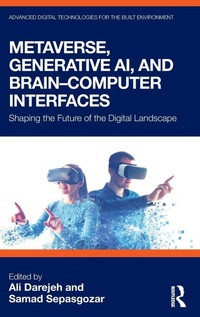
Metaverse, Generative AI, and Brain-Computer Interfaces
Shaping the Future of the Digital Landscape
1st Edition
Will be published approx. on 26. February 2026
Book
Hardback
310 pages
978-1-032-89678-6 (ISBN)
Description
This compelling exploration delves into the heart of cutting-edge technologies, specifically the Metaverse, Brain-Computer Interfaces (BCI), and generative artificial intelligence (AI). The authors unravel their transformative applications in shaping the future and contemplate how the next generation of virtual environments will manifest, as well as how the digital landscape can be affected.
The book encompasses various examples of the Metaverse, brain-computer interfaces, and generative AI across diverse fields, including education, engineering, and medical science. In the dynamic realm of the Metaverse, where virtual realities converge, the book showcases how these innovations can transform the way we learn, interact, and build. Through Brain-Computer Interfaces (BCIs), users can directly interface with technology using neural signals, opening up new avenues for communication and control. Additionally, generative AI algorithms empower us to create immersive virtual environments and generate content with unprecedented creativity.
Whether you're a student, educator, or industry professional, this book is your ticket to understanding and harnessing the power of the future. It provides a pathway for those who believe in the limitless possibilities that the Metaverse, BCI, and generative AI can bring to our daily experiences.
The book encompasses various examples of the Metaverse, brain-computer interfaces, and generative AI across diverse fields, including education, engineering, and medical science. In the dynamic realm of the Metaverse, where virtual realities converge, the book showcases how these innovations can transform the way we learn, interact, and build. Through Brain-Computer Interfaces (BCIs), users can directly interface with technology using neural signals, opening up new avenues for communication and control. Additionally, generative AI algorithms empower us to create immersive virtual environments and generate content with unprecedented creativity.
Whether you're a student, educator, or industry professional, this book is your ticket to understanding and harnessing the power of the future. It provides a pathway for those who believe in the limitless possibilities that the Metaverse, BCI, and generative AI can bring to our daily experiences.
More details
Series
Language
English
Place of publication
London
United Kingdom
Publishing group
Taylor & Francis Ltd
Target group
College/higher education
Professional and scholarly
Academic, Postgraduate, and Professional Reference
Product notice
sewn/stitched
Cloth over boards
Illustrations
34 farbige Zeichnungen, 109 Farbfotos bzw. farbige Rasterbilder, 143 farbige Abbildungen
34 Line drawings, color; 109 Halftones, color; 143 Illustrations, color
Dimensions
Height: 234 mm
Width: 156 mm
Thickness: 22 mm
Weight
708 gr
ISBN-13
978-1-032-89678-6 (9781032896786)
Copyright in bibliographic data and cover images is held by Nielsen Book Services Limited or by the publishers or by their respective licensors: all rights reserved.
Schweitzer Classification
Other editions
Additional editions
Ali Darejeh | Samad Sepasgozar
Metaverse, Generative AI, and Brain-Computer Interfaces
Shaping the Future of the Digital Landscape
E-Book
02/2026
1st Edition
Routledge
€73.99
Available for download
Ali Darejeh | Samad Sepasgozar
Metaverse, Generative AI, and Brain-Computer Interfaces
Shaping the Future of the Digital Landscape
E-Book
02/2026
1st Edition
Routledge
€73.99
Available for download
Persons
Dr. Ali Darejeh is a faculty member and researcher at UNSW specializing in AR/VR, brain-computer interfaces, serious games, and educational technology. His work integrates emerging technologies with educational psychology. He also brings extensive industry experience as a UX researcher and gamification designer across healthcare, oil and gas, and finance sectors.
Associate Professor Samad Sepasgozar is a global leader, ranked among the top 5 in Digital Twin and a world leader in Architecture (Computer Science and Engineering), with numerous scholarly publications. A leading educator, he pioneers innovative teaching tools and sustainable solutions, engaging 50,000+ global attendees with transformative digital technology insights.
Associate Professor Samad Sepasgozar is a global leader, ranked among the top 5 in Digital Twin and a world leader in Architecture (Computer Science and Engineering), with numerous scholarly publications. A leading educator, he pioneers innovative teaching tools and sustainable solutions, engaging 50,000+ global attendees with transformative digital technology insights.
Content
Chapter 1: The Metaverse and Emerging Technologies: Transforming Education and Beyond, Chapter 2: Metaverse and Virtual Reality Integration in Mechanical Engineering: Applications in Virtual Labs, and Training, Chapter 3: Metaverse and Virtual Reality Integration in Electrical Engineering: Applications in Virtual Labs and Training, Chapter 4: Metaverse and Virtual Reality Integration in Medical Science: Applications in Virtual Labs, and Training, Chapter 5: Metaverse and Virtual Reality Integration in Computer Science: Applications in Programming Education, Chapter 6: Metaverse and Virtual Reality Integration in Filmmaking Education: Applications in Cinematography and AI Feedback, Chapter 7: Metaverse-Enabled Virtual Museums: A Systematic Review and Empirical Study on Immersive Cultural Heritage Applications, Chapter 8: Framework for Real Time Robotic Manipulation in the Metaverse Using Digital Twins and Reinforcement Learning, Chapter 9: Privacy and Ethics in Educational Metaverse Platforms: Risks, Regulations, and Design Strategies, Chapter 10: Generative AI for Education and the Metaverse: Intelligent Virtual Instructors, Chatbots, and Recommender Systems, Chapter 11: Generative AI for Image Synthesis: Applications in Construction, Architecture, and Metaverse Design, Chapter 12: Leveraging Brain-Computer Interfaces to Advance Interaction Within the Digital Landscape, Chapter 13: A Roadmap for Intelligent Metaverse-Based Learning Environments: From Lessons Learned to Practical Frameworks