

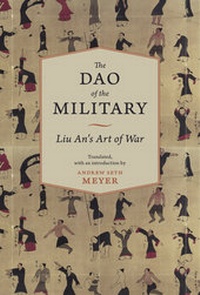
The Dao of the Military
Liu An's Art of War
Columbia University Press
Will be published approx. on 3. July 2012
Book
Hardback
176 pages
978-0-231-15332-4 (ISBN)
Description
Master Sun's The Art of War is by no means the only ancient Chinese treatise on military affairs. One chapter in the Huainanzi, an important compendium of philosophy and political theory written in the second century BCE, synthesizes the entire corpus of military literature inherited from the Chinese classical era. Drawing on all major, existing military writings, as well as other lost sources, it assesses tactics and strategy, logistics, organization, and political economy, as well as cosmology and the fundamental morality of warfare. This powerful work set out to become the last word on military matters, subsuming and replacing all preceding literature. Written under the sponsorship of Liu An, king of Huainan, the Huainanzi's "military methods" emphasize the preservation of peace as the ultimate value to be served by the military, insisting that the army can be effectively and rightly used only when defending the sacred hereditary position of the emperor and his vassals. This position stands in stark contrast to that of The Art of War, which prioritizes the enrichment and empowerment of the state.
Liu An's philosophy also argues that military success depends on the personal cultivation of the commander and that deception is not enough to secure victory. Only a commander with the exceptional qualities of insight and cognition, developed through a program of meditative practice and yogic refinement, can effectively control and interpret the strategic situation. Andrew Seth Meyer offers both a full translation of this text and an extensive analysis of its historical context. His thorough treatment relates Liu An's teachings to issues in Chinese philosophy, culture, religion, and history, helping to interpret their uncommon message.
Liu An's philosophy also argues that military success depends on the personal cultivation of the commander and that deception is not enough to secure victory. Only a commander with the exceptional qualities of insight and cognition, developed through a program of meditative practice and yogic refinement, can effectively control and interpret the strategic situation. Andrew Seth Meyer offers both a full translation of this text and an extensive analysis of its historical context. His thorough treatment relates Liu An's teachings to issues in Chinese philosophy, culture, religion, and history, helping to interpret their uncommon message.
Reviews / Votes
The Dao of the Military makes a welcome addition to the growing literature on early Chinese strategy. The translation is exacting and felicitous. It should serve well for those interested in the history of Chinese thought and Chinese military thought. -- Victor H. Mair, University of Pennsylvania With its highly competent translation and penetrating analysis, this volume will be a valuable antidote to the widespread misapprehension that Sunzi's Art of War and Chinese military thought are essentially coterminous. -- David A. Graff Journal of Military History A valuable contribution to the field of Chinese military history. -- Kai Filipiak Monumenta SericaMore details
Series
Language
English
Place of publication
New York
United States
Target group
Professional and scholarly
College/higher education
Product notice
Trade binding
Dimensions
Height: 210 mm
Width: 140 mm
Weight
326 gr
ISBN-13
978-0-231-15332-4 (9780231153324)
Copyright in bibliographic data and cover images is held by Nielsen Book Services Limited or by the publishers or by their respective licensors: all rights reserved.
Schweitzer Classification
Other editions
Additional editions
The Dao of the Military
Liu An's Art of War
E-Book
07/2012
1st Edition
Columbia University Press
from
€31.39
Available for download
The Dao of the Military
Liu An's Art of War
Book
07/2012
Columbia University Press
€24.78
Article not available at the moment
Persons
Andrew Seth Meyer is associate professor of history at Brooklyn College. With John S. Major, Sarah A. Queen, and Harold D. Roth, he is the cotranslator and coeditor of The Huainanzi and The Essential Huainanzi. John S. Major taught East Asian history at Dartmouth College from 1971 to 1984. Since then, as an independent scholar, writer, editor, and lecturer, he has published many scholarly and general-interest books on Asia.
Content
Foreword, by John S. Major A Note on the Translation Introduction An Overview of the Military Bibliography Index