

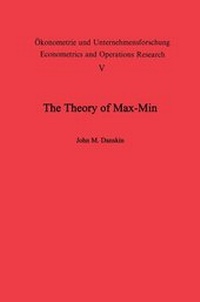
The Theory of Max-Min and its Application to Weapons Allocation Problems
1st Edition
Published on 1. January 1967
Book
Hardback
X, 128 pages
978-3-540-03943-3 (ISBN)
Description
Max-Min problems are two-step allocation problems in which one side must make his move knowing that the other side will then learn what the move is and optimally counter. They are fundamental in parti cular to military weapons-selection problems involving large systems such as Minuteman or Polaris, where the systems in the mix are so large that they cannot be concealed from an opponent. One must then expect the opponent to determine on an optlmal mixture of, in the case men tioned above, anti-Minuteman and anti-submarine effort. The author's first introduction to a problem of Max-Min type occurred at The RAND Corporation about 1951. One side allocates anti-missile defenses to various cities. The other side observes this allocation and then allocates missiles to those cities. If F(x, y) denotes the total residual value of the cities after the attack, with x denoting the defender's strategy and y the attacker's, the problem is then to find Max MinF(x, y) = Max [MinF(x, y)] .
More details
Other editions
Additional editions
E-Book
12/2012
Springer
€53.49
Available for download
Book
03/2012
Springer
€53.49
Shipment within 7-9 days
Content
I Introduction.- II Finite allocation games.- III The directional derivative.- IV Some Max-Min Examples.- V A basic weapons selection model.- VI A model of allocation of weapons to targets.- VII On stability and Max-Min-Max.